By Michelle ElvyReprinted with permission from Michelle Elvy’s Glow Worm Blog, September 14, 2012
When Christopher Allen asked me to join his Blog Tour for his new novel Conversations with S. Teri O’Type, I said yes–without having read the book. It was not much of a gamble, saying yes to Chris. I’ve read a lot of his work. I’ve nominated one of his short stories for a Pushcart Prize. He doesn’t disappoint. And his new novel (yes, I’ve read it by now) is no exception. This book kept me chuckling all the way and I want it to be HUGE–like big bouffant hair huge. So I’m pleased to take part in this big beautiful blog tour.
Here’s how our own conversation developed…
(Note to readers: I spoke to Christopher from New Zealand, so my questions are written in Kiwi English, but I’ve left Chris’s responses, unedited, in American English. Don’t let that distract you. Whether you see it as ‘humour’ or ‘humor’, this book is damn funny.)
ME: Chris, one of the things we’ve talked about before is the success of flash fiction and the increasing desire among such a variety of readers to embrace episodic literature. Even though the traditional long-winded biography still exists, we find ourselves turning often to collections that offer threads through a life, but in short bursts of colour as opposed to long-handed blending of hues. Grey is out; fuschia is in–at least I think that is what S. Teri O’Type would say. Or am I stereotyping Teri (but not Curt)? So let’s begin there. Why do you think episodic literature appeals, and why does this particular story fit into the episodic genre? Is it because it flits–to use one of Curt’s newly acquired and realised expressions–or is there something else going on?
CA: Hi, Michelle! I think there’s certainly room for both long, grey strokes and sudden bursts of fuschia in contemporary literature, but we are turning more to the sudden and the unexpected—and I think TV has a lot to do with this. The average situation comedy is 22 minutes long, around 30 minutes with commercials. And thank goodness for the commercials! We’d probably get bored now if we had to keep our eyes on the TV for 22 minutes. We’ve been conditioned by television to feel the story arc more quickly, and since TV is at the core of Conversations with S. Teri O’Type it just made since to give the lessons an episodic structure.
ME: Do you see these episodes in film form? As images before you? And have you imagined it transforming into episodes for a viewer, as opposed to episodes for a reader? In other words, did you set out to make it this splash of visual colour or did it just turn out that way?
CA: Good question. I don’t think I’ve ever written a story that didn’t happen—at least for me—like a film. I suppose this is just another influence of television on my brain. The voices, though, are stronger than the setting, which is usually a parody of the typical situation comedy set. I think most readers have this set(ting) well anchored in their minds: three walls a couch and the fourth wall (the audience). Anything else in the room is gravy.
Several readers have told me I should write the Conversations for the stage. I have my reasons for not having done so. In the end, I decided to keep Teri and Curt as voices in the reader’s head and let the reader imagine—as much as possible—how they look. I didn’t set out with these questions in mind, but the constant feedback from workshop comrades forced me to consider issues like form and setting. The episodic nature of the story was there from the beginning of course.
Episodes, when you think about it, are not very much different from a class you take in school. You have short bursts of learning followed by hours or days of reflection. As a teacher, I’m keenly aware of the dwindling human attention span. I have to change gears every 10-15 minutes in my own classes. And Curt—poor Curt—has a learning disability. He needs his lessons in Greater Gayness in small doses.
ME: And these doses are very effective. The reader, like Curt, gets to observe lessons in Greater Gayness as well. We realise we all have ‘gayspectations’–even as Teri’s are high and Curt’s are almost non-existent. So here we have a lesson unfolding bit by bit. In the end, do you think it’s more about lessons in GG (Greater Gayness) or something else entirely? Something even literary perhaps? (Literary with a boa, for Teri’s sake.)
CA: Well, I’d like to think the Conversations hold literary water. I’ve often toyed with banging the book into the genre of literary humor, but I’ve never researched enough to know whether “literary humor” is even a genre. These lessons in Greater Gayness are indeed something else entirely, and Teri is someone else entirely as the old buddy he claims to be. I’ve tried to be subtle enough so that the reader doesn’t lose interest in Teri’s “efforts” to “help” Curt.
Satire is slippery. Is there anything more misunderstood? When I first started workshopping the Conversations, I got dozens of responses every day. I’d open one that said something like “OMG! I KNOW someone just like OMG! and I love him!” and then one that would say “How dare you make fun of gay men! Are YOU gay? I’m appalled!” And then I would make the “I’m appalled” gesture to myself—spread palm to clavicle per Teri’s example—and laugh. Neither one of these readers understood what I was doing. I’m going to be misunderstood. I know that. And that’s why I know it must be literary.

ME: Which gets me to my next point–how we communicate and the pitfalls of our inability to say what we mean. So much in these conversations is about communication and (mis)communications. Curt using expressions like “DUDE” and Teri saying “Is that even a word?” Or Curt saying “awesome” and Teri countering sharply that what he really meant was “it’s redolent of a breezy Alpine Alm with a hint of sage and mandarin orange blossoms.” It’s Teri’s very specific take on Gaydom, in fact, that makes him stand out–that makes him such a specifically memorable character. And yet, this is about more than the specificity of language and designer label–this is about the specificity of identity. So tell us, if the grey-and-lilac-pinstripes of the $300 shirt don’t matter to Curt, what exists between those lines and why does that matter?
CA: I want to get to that shirt, but first I’d like to go back to the theme of (mis)communication. It’s a big one in the story. Teri constantly misinforms Curt; in fact, you might say the stereotype misinforms Curt, even tries to deform Curt. (Un)fortunately, Curt never understands anything Teri teaches him—which is, for him, a triumph. Wait, he does figure out how to hang a picture at eye level—if the eyes belong to someone tallish.
That shirt. Well, can I admit something, just between you and me and the thousands of people who’ll read this interview? Yes? I would love to have that shirt. Curt, on the other hand, is an accounter. He thinks about these things much more rationally than I do. He’s not a character who can read between the grey-and-lilac lines. Sometimes I like to feel the beauty of designer clothing. I would never pay $300 for one though. To answer your question, superficiality lies between those lines. Clothing in fact is a sweet metaphor for superficiality.
ME: And from there we move right to the theme of ‘trappings’ and form. The way you play with form here is great fun. Without giving too much away, I refer to the play-within-a play, the riff on Dickens, the Tchaikowsky moment (Errrrrrrski!), and an early reference to those silly sitcom laugh tracks but then the recurring mysterious laugh emanating from the wall behind the yucca. And then there’s a meta-moment which threatens to undo Teri altogether if he can’t keep the audience laugh-track on straight. So which is more important here for you as a writer–form or content? The means or the meaning? Or is it all wrapped up in one large, ahem, package?

CA: The trappings. The trapped. The traps. Packaging. I’m trying to start a sentence here. The trappings are so VERY important to Teri: the outer shell, the facade of the gay man. Who cares what’s really going on inside the sitcom character’s soul? We just want to be entertained regardless of content. That’s Teri, and he very much holds the reins—or the whip—in this story.
Form is important for me as the writer. Parody and allusion play huge roles in this satire for lots of reasons. I like parody. I’m not sure if this is reason number one, but it’s up there in the ranking. Teri is a congregation of characters. There are rare moments when something like a real person peeks through his facade, but usually he’s impersonating some other character from a sitcom or often just playing a role he thinks will entertain. I hope the readers feel as if they are constantly asking themselves, “Do I want to be entertained? Is it OK to laugh? Do I want/need Curt to be Teri?” Would it be wrong to say that form is content in this satire? May I go the “large, ahem, package” route? Well, who wouldn’t want to?

ME: Indeed. But let’s get serious here for a moment. Deep down, this is a story of existential angst in the midst of all this slapstick, epitomised by Teri’s monologue about the meaning of the shag–or the lack thereof. So let’s talk a bit about the relationship between satire and existential angst. Did you start out intending to tackle both?
CA: Yeah, I did. I think I said this in another interview, but I’ll repeat it here: There’s nothing serious here except everything. That moment when Teri steps out of character to talk about real sex has always stopped me and made me hug the monster. For a moment he actually says there’s no difference between gay and straight people when all the trappings are thrown off and we’re lying naked in our own bedrooms. This scares the hell out of Teri.
It was Kate Brown, a British filmmaker living in Berlin, who asked me if I could have written this story in another form. I don’t think I could have written the story as a deep, grey existential work without the slapstick; I don’t think I’ve ever seen the world without both. This probably means that I’m also trapped between the need to entertain and the need to find myself. I’d like to see this as balance.
ME: Balance–which has everything to do with power. So here comes the last set of questions, Chris. We touched on Michel Foucault in an earlier conversation (yes, Facebook – where else?) which makes me wonder about those more serious themes underlying the slapstick quality of this laugh-out-loud conversation between the muddled Curt and the dominatrix diva Teri. Tell me, do you think there’s something happening here that says more about power than we see at first glance? In a humorous way, are you driving at some kind of better understanding in terms of power and identity? How does power inform the relationship between Teri and Curt? And, finally, who would play Michel Foucault if he were to make a special appearance in the sitcom version of Conversations with S. Teri O’Type?
CA: First of all, I’d like to marry this question. I’m glad I’ve woken up to it this morning. Teri and Curt’s relationship is all about knowledge, power and who’s pulling the strings. Teri has all the power because he supposedly has all the knowledge. As you say, he’s cast as a domanatrix, but he also takes the forms of director, Kung Fu Master, Santa Claus, Dog whisperer, and even Bea Arthur. I hope, however, if readers look more closely they’ll see that Teri’s “knowledge” is almost always misinformation–deliberately so. It was Marcus Speh that mentioned in a review that Teri is a trickster, and he’s so right. Teri is the übertrickster. I think it’s a beautiful coincidence that this volcanic imbalance of knowledge/power is exactly what makes their conversations humorous (I hope).
There is another element to the theme of power in the Conversations. Teri, Curt and Cary Grant are not the only characters here. There’s an audience, which Curt gradually learns to accept, to hear their praise and their disappointment. In the end, it’s the power of the audience that Teri can’t overcome. Does Curt learn to turn off the laugh track? I don’t know.
Michel Michel. Cary Grant usually takes on the guest appearance roles. He’s done Naomi Campbell, Eddie Murphy’s Donkey, Tiny Tim, Eddie Murphy’s Donkey ímpersonating Tiny Tim, Tchaikovsky, Eddie Murphy’s Donkey impersonating Tiny Tim in the body of Chewbacca, and Sophia from The Golden Girls. He’s so versatile that I think he’d be able to do Foucault with his paws tied behind his back. He would only speak French of course. Errrrreaux! and Errrrrelle! but Teri would translate (horribly and incorrectly). Curt would have absolutely no idea what was going on. I’m sure the topic of the lesson would be The Prison Day.
ME: And now, finally, something your readers will surely want to know: if you did have a dog, would he be named Dilbert or DeBarge?
CA: I would have to look into the pup’s eyes to know his name. I wouldn’t want him to be stuck for dog’s years with the wrong name. But Dilbert is much more versatile than DeBarge. I could call him Dil or Bert, but I’d probably end up calling him fella anyway.
ME: Thank you, Christopher Allen, for your honesty, your wit and your book!
* * *
About the author and the book:
Christopher Allen is the author of
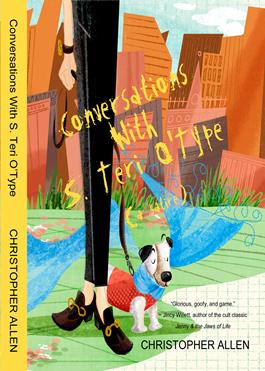
Conversations with S. Teri O’Type (a Satire). His fiction and creative non-fiction have appeared in numerous journals and magazines both online and in print. In 2011 Allen was a finalist at Glimmer Train and a Pushcart Prize nominee. Christopher is an editor, teacher and an obsessed traveller. He blogs at
www.imustbeoff.com. For more about his book, visit:
the Conversations blog tour.

 May 10 PS serial chap 1 (390)
 It’s May–Short Story Month–and all kinds of fun stuff is happening. For example, Julie Duffy over at
























 Gay Degani