KIRKUS Gives Me Very Little Love

My Kirkus review for What Came Before is in and though I seriously considered not publishing it (when you pay $400 dollars for a review, they kindly let you opt-out of having it available to the reading public), I owe it to myself and others to share it.  Doesn’t everyone get lousy reviews?

I remember some old black-and-white movie in which a director, the producers, and actors gather in a restaurant (Sardi’s?) waiting for the newspaper reviews after the debut of their play.  All About Eve comes to mind, but maybe not.

Anyway, reviews, it is posited, can make or break a play, a movie, a book. As creative people, we think we need them and we think what we’ve done may be good enough for a good review, but not every piece of work will appeal to everyone. The question is, should a review hurt our chances of success?

I don’t think so.  I hope not.

How many times have I read in the Los Angeles Times that this movie or that movie is a transcendental experience or a piece of garbage, and after seeing said movie wonder, what the hell?  To use a cliche (a writing flaw my anonymous critic accuses me of), beauty is in the eye of the beholder.

I just read the other day that curriculum honchos in schools in England have dropped Of Mice and Men and To Kill a Mockingbird from required reading lists. The Huffington Post has tried to make us writers feel better by publishing in 2012 “Bad Reviews of Great Authors.”  Here are a couple of examples:

“Wuthering Heights” by Emily Bronte
“There is not in the entire dramatis persona, a single character which is not utterly hateful or thoroughly contemptible.”

– Atlas, 1848

“The Great Gatsby” by F. Scott Fitzgerald
“no more than a glorified anecdote, and not too probable at that… Only Gatsby himself genuinely lives and breathes. The rest are mere marionettes—oftenastonishingly lifelike, but nevertheless not quite alive.”

– H.L. Mencken, Baltimore Evening Sun, 1925

“Lolita” by Vladimir Nabokov
“Unfortunately, it is bad news. There are two equally serious reasons why it isn’t worth any adult reader’s attention. The first is that it is dull, dull, dull in a pretentious, florid and archly fatuous fashion. The second is that it is repulsive.”

LET ME BE CLEAR!  I am in no way claiming my little book is anything like the books we commonly love and admire.  However, what I am saying is that although there are some valid points to my critic’s analysis (occasional cliches, clues too easy, lacking “gravitas”), it seems to me that he/she hasn’t given me much credit for the things some of my readers believe I did accomplish.  “Unsatisfying” I think is the word that struck me as NOT the common experience.

There are a couple hints in the review that perhaps it has some merit, but none proffered without a “but,” an “although,” “that said,” or “nevertheless,” making it difficult to use the good bits without feeling as if I’m cheating.

So here’s the link to the KIRKUS REVIEW.  Although reading it may discourage a read or two, but if you want to give What Came Before a chance–and hopefully see for yourself if you like it–it’s still online FREE online, all seventy chapters at EVERY DAY NOVELS.

And yes, if you agree or disagree with the review, Kirkus allows for comments.

You can also purchase it for KINDLE or in a gift edition hardback at AMAZON.com or BN.com.  Trade paperback is coming soon. Other ebook options at Tomely.

In Jayne’s World, we have to write…

Jayne Martin offers up a challenge this morning to get us writing after the long weekend.  (There was a weekend?)  
Per Jayne:

The challenge:  Write a story (beginning, middle and end) that hints at a larger story, but is complete within itself, in 25 words or less.  The most famous piece of hint fiction was written by Hemingway:
            For sale:  Baby Shoes.  Never worn.
Hint Fiction demands reader involvement.  “Why were the baby shoes never worn?” we’re left to contemplate.   It hints at much more, yet is complete in and of itself. 

Write your story on your own blog, then come back here and link up your post.  Be sure and visit everyone else’s offering and support your fellow writers with a comment.  If you don’t have a blog, you may leave your story in my comment section below.  Write and post as many as you want.   Link-up will be active through June 1st.  
Have fun!

Want to know more about hint fiction?   Visit Robert Swartwood’s Hint Fiction website by clicking here. 

Here’s mine:

Second Thought
Smelly toes, phlegmy cough, blanket hog. Where’s dinner? he mumbles, shuffling in.  Eyes meet. He strokes my cheek. Memories swirl. Arsenic in my pocket weighs.
Join the fun.  Write your own, visit her site, and “link up:” HERE

Coach Your Story Like Your Name is Erik Spoelstra

This article is reprinted from Flash Fiction Chronicles. It appeared during the NBA play-offs in 2012. I don’t remember which game it was–maybe game 5?–II wanted to post it again since we just may have another Heat v. Thunder play-off.

What a terrific game.  I just hope the Thunder can come back so the series goes to seven.  Nothing like great basketball to get me thinking about teamwork and how it applies to writing. The writer is the coach.  The team: each member is a story element and they must work together to WIN.   (Indulge me here.  Everything seems like a metaphor for writing to me!)
Think about it.  The coach is the one who teaches, guides, plans, shapes, and has a heart attack when all the teaching, guiding, planning, shaping doesn’t work.  The team has potential, it may even have talent, but if left to their own devices, the members might play well, might even be brilliant, but going all the way, reaching for that trophy?
The big man might not let the others play because he never gives up the ball.  The point guard might try to get everyone to pay attention, to work the ball around to the player with the best “look,” but maybe there’s a bumping battle for position in the key and the player misses the pass.   You’ve heard it before from the master himself, Michael Jordan,  ”Talent wins games, but teamwork and intelligence wins championships.”  And whose job is it to bring teamwork and intelligence to the court?  The coach.
So how does that apply to writing?  You guessed it, the author is the coach.  He or she is the person in charge, the one who makes the tough decisions, who inspires, motivates, and keeps everything on track.  The starting team includes structure, language, content, theme, and characters with dialogue, setting, clarity, metaphor, and imagery coming off the bench.
The coach puts his first team on the court.  The best players, but he has to switch them out when something isn’t working and he has a strong bench to do so.  Maybe for one story, language is the focus–the element that never lets the author down,  for another, structure, but no matter what strategy the coach decides will work, he has to count on all the elements to do their part.
I love Blake Griffin.  Watched him in the NCAA championships and there was something about him that stood out (damn good basketball) and I remembered him, so when he ended up on the Clippers, I was excited.  We went to a couple games and the Clippers suddenly had enough  talent that we dared to hope they would be contenders, but they didn’t always play as a team.  Whoever had the ball tended to shoot.  There was little working around the floor and while Chris Paul and Blake Griffin might be two of the most talented players in basketball, they could not bring it in the end without the rest of the team.
The same is true in putting together a story.  An author might be brilliant with words, stringing them together like easy lay-ups, but a story needs more than pretty words.  It has to have meaning.  It has to stir something in the reader.  Occasionally, of course, an imagery-rich story might be enough, something there beneath the lines that works for many readers, but we’re talking about the long haul here, making it to the finals, to the championship. Sharp original language is like having a superb big man.  You might win over fans for a few stories, but at some point, the  author needs to send in the rest of the team.
Language, structure, and content need to work together and still have room for the other elements to play their part in order for a writer to produce championship work.  Writing is like coaching.  You can’t just put your best two players in the game and hope they can bring home the  NBA Trophy while you cheer them on.   You need to coach everyone on the team.  You need to get each one to contribute the best version of their skills to the play.
If you saw the game last night, important plays were made by bench-warmers Nick Collison for the Thunder and Norris Cole for the Heat.  And what about Mario Chalmers?  We expect to be cheering Dwyane Wade and LeBron, but Bosh?  And while Russell Westbrook scored a valiant 32 points, the Thunder lost because yes, late in the game, his team ran out of gas.
So enough of this.  You get the point. We writers need to consider how all the elements of a story can contribute to the overall story and while one or the other may dominate, it is the contributions from the bench that will often carry the day.

Podcast Interview-Robert Swartwood Asks Me About WCB

Robert Swartwood, the USA Today bestselling author of The Serial Killer’s Wife, The Calling, and Man of Wax asks some good questions about What Came Beforeincluding how serialization of the novel came about.  The podcast is available at his website HERE.
Robert’s  work has appeared in The Los Angeles ReviewThe Daily Beast,  Postscripts,  ChiZine, Space and TimeWigleaf, and PANK. He created the term “hint fiction” and is the editor of Hint Fiction: An Anthology of Stories in 25 Words or Fewer. He lives with his wife in Pennsylvania.


Chapter 1 of What Came Before Read by Me

Have your been wondering about Chapter 1 of my suspense novel?  Here’s a taste of What Came Before!  

Available for purchase in hardcover at Amazon (http://amzn.to/PEQhhy) or B&N (http://bit.ly/1gxuJcr) or read the serialized version here:  http://everydaynovels.com/whatcamebefore/chapters/1/

About What Came Before:

Fed up with being tied down by twenty-five years of domestic bliss and everyone’s expectations, Abbie Palmer, struggling to find her creative self and asserting some independence from her husband, moves into the Tiki Palms. When he tells her, “You’ll be lonely. No man is an island,” she flings back, “That’s exactly what I want to be, an island. I’m sick of being a whole continent.” But breaking away isn’t so easy, what with cops, Molotov cocktails and Hollywood starlets, lost memories — and maybe an unknown half-sister…

What Came Before in the World

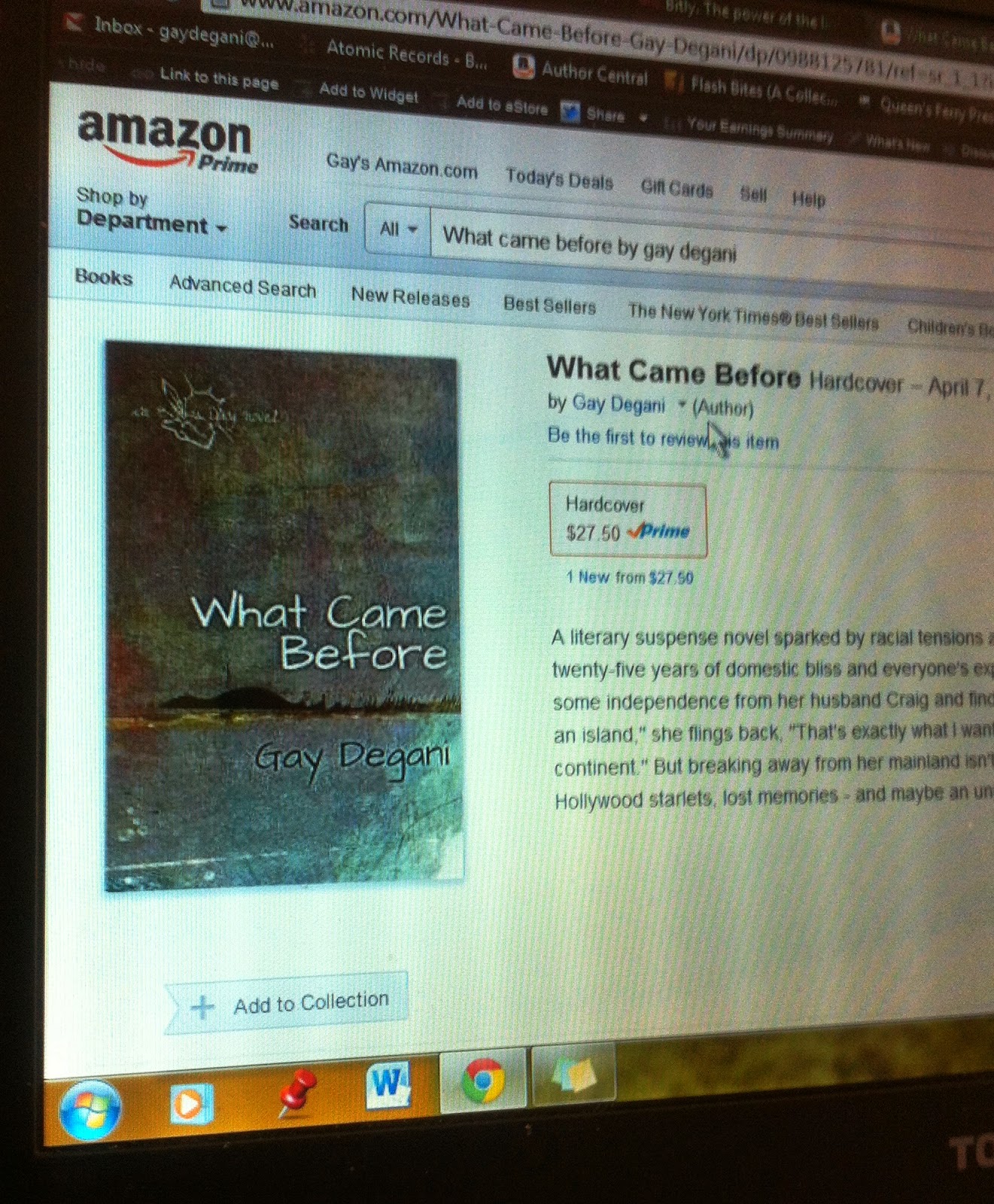
Although the official launch date for What Came Before hardcover gift edition is Monday, April 7, both Barnes and Noble and Amazon have it posted for sale on their respective sites.  You can also read it online at Every Day Novels.

How What Came Before Came to Be

What Came Before was conceived as a comedy with lots of broad humor and exaggerated characters, but as I began to work, I realized I needed to write about something I cared about, that there had to be a reason beyond car chases for a piece of writing to exist. I rethought the whole thing, asking myself, what would be interesting to me, important for me to say. Stories–good stories–had to be about something that mattered, either to me and/or to others.

In the beginning, Abbie’s missing half-sister was white, like Abbie and like me, and I kept running up against my own question, “so what?” “Where’s the tension?”  I reached into my own life, my own experiences, my own childhood.

I grew up in California, but my mom came from a little town in Louisiana and my dad from Iowa.  Since my dad was a teacher, we climbed into our old Pontiac as soon as school was out and headed east to corn country, then down to Terrebonne parish.  That’s where I ran smack dab into Jim Crow laws.
I loved going to the grocery store with my grandpa.  He was a sunburned Santa Claus who smelled of figs and cigars, filling our cart with rolls and rolls of toilet paper, paper towels, cans of tomato sauce and bottles of soda pop.  I liked to hold onto the front and ride while he pushed through the aisle. Then at some point when I was four or five – I don’t really remember exactly when – he let me go in search of a drink of water by myself.
I stood in front of two water fountains instead of one wondering which one I wanted. I’d never had a choice like this before.  Not in California. 
One was labeled “white” and one was labeled “colored.”  What would most little kids chose? I chose “colored,” of course, because to my mind that meant the water would come out like a rainbow: red, orange, yellow, green, blue, purple. When it didn’t, I was disappointed. I tried the white one. The two sprays of water were exactly the same.  I was confused and angry.
I ran back to my grandpa. He said one was for white people, the other was for “colored” people. When I asked why, he just shrugged. I don’t remember for sure, but I think it was my father who explained it to me, that this kind of thing existed in the world.
And I wish I could say I knew instinctively at that young age the wrongness of it, but I didn’t. It’s something I have learned as I’ve grown into myself, through reading, through the experiences of the growing up in the fifties and sixties, through watching the news filled with civil rights marches, the Watts riots, and assassinations (MLK, Medgar Evers, Malcom X), how human beings tend to exist in a real world. “What Came Before” springs from a desire to show that people are more alike than different and that our differences enrich us. 

We are Twenty-One Chapters Into What Came Before

That’s right. WCB has been up at Every Day Novels now for four weeks, moving into week five.  And if you don’t know what I’m talking about it’s my serialized suspense novel at Every Day Novels.  It’s free through the entire book, but just so you know, once it’s over, it will be removed from the internet and only be available in a hardback gift edition, paperback, and e-book formats.

What Came Before is the story of Abbie Palmer who decides once her children are gone, she’s going to take a break from her husband to pursue creative endeavors – just for the summer, a kind of personal-growth camp.  Her head is about to burst with everything she wants to do, paint, write, make jewelry, knit, reupholster furniture.  She even has an old electric fry pan tucked under the marriage bed with large blocks of beeswax.  She wants to learn how to batik!

Her husband rolls his eyes and keeps coming up with other things they have to do, she has to do, so she decides to take a “leave of absence” from her marriage, but just when she settles into her tiny apartment at the Tiki Palms, she runs into murder, cops, and repressed memories from her past.

Anyway, I don’t want to give away too much.  I want you to read the book on the edge of your seat which some readers have told me they’ve been doing.  If you haven’t started reading yet, here’s the link: WCB

Hard Cover Due April 7

And there’s more news.  Every Day Novels editor and publisher, Camille Gooderham Campbell, has told me the hardback edition of WCB will available for purchase on April 7!!!!  If any of you reading this live in the Los Angeles area and would like me to visit your book group or if you’d like to get some friends together to party, contact me at gaydegani@gmail.com.  I’m happy to come, read some of the story, and talk about the novel and/or about writing itself.

This Time I’m Starting the Game

Susan Tepper tagged me in a recent merry-blog-go-round about writing process, but having been tagged by someone else I decided to come up with new questions and I thought it would be interesting to ask writers about their characters.  This came out of a discussion at FFC’s New and Emerging Writers Group which focuses on the art and craft of writing.  The discussion question, posed by Jim Harrington, FFC’s Managing Editor, was, “How do you select character names?” I want to expand on that, so here are some new questions for writers who want to play along.  I’ll start with my own answers.
1). What surprises you about your characters? And why?

I’m always surprised that they show up because I rarely begin a story with a character in mind. Usually I begin with a situation and then just GO.  I suppose this means they come out similar to me, especially if I start with a first person narrative and that makes sense because the situation—if told from the “I” viewpoint usually resembles something I’ve been through.  The third person pops up if the situation isn’t that close to home.  I’m surprised I just admitted that. 
2). What do you draw upon to create your characters?

Of course as with most writers, I pull my characters from myself, from people I know, and from people I observe, but rarely have I ever consciously created a character from a single person.  I remember one case where the character is exactly like real life but the details are changed.  Other than that, most of the time my characters spring from what I know—or think I know—then evolve with the story as I make decisions—or I’m led toward decisions.  This is where it gets a little loopy, the chicken and the egg syndrome.
3). Out of all of the characters you’ve created, who is your favorite and why? Please name the story and supply a link if that’s possible.

Right now it’s Abbie Palmer who is the main character of my suspense novel, What Came Before.  She is a lot like me in so many ways, but certainly she has been molded to fit the story.  There is a reason why I don’t do memoir because my own life has been extremely ordinary and satisfying. This is not what good drama is made of.  Another favorite who is alive now in Pure Slush’s 2014-A Year in Stories anthologies is Sybil.  She a landlady who has managed her life fairly well but there’s something in her past that she’s dealing with, and her ability to be everyone’s go-to person is slipping away.
4) Are there any characters you are not quite done with yet?  What other challenges do you want to give him or her?

I have two published short-stories about Nikki Hyland, Slacker Detective.  I would like to write a few more shorts or even a novel continuing to challenge her to get her you-know-what together.  Her first story can be found in LandMarked for Murder along with several other stories from members of the Los Angeles chapter of Sisters-in-Crime.
5). How do you select character names?

Sometimes names just pop into my mind and sometimes I research, looking for subtly suggestive, as in the case of Sybil, the landlady I mentioned before.  I wanted her to have an old fashioned name to suggest her age and her wisdom.  I haven’t quite used this allusion to its fullest yet and I may not.  I don’t ever want names to be obvious, but rather to hint at something deeper. This though doesn’t always happen.  Sometimes a name is just a name. 
Who am I going to tag?  Susan Tepper, Nate Tower, and H.L. Nelson

Tagged-My Writing Process

“My Writing Process” is a series of blog posts in which authors ‘tag’ each other to answer questions about their work. Stephen V. Ramey asked meto take part, along with Jamie Lackey.
Stephen is an American author of contemporary and speculative fiction. His short stories and flash fictions have appeared in dozens of venues from Microliterature to Daily Science Fiction. His first collection, Glass Animals, is available from Pure Slush Books.
So here are the questions:
What am I working on?
My suspense novel, What Came Before, has just been released online at Every Day Novels. A lot of work went into getting it ready first for online and then for print, but I think that phase is coming to a close.  Now I’m in promotion mode. 
However, I do have a second exciting project that I am still deeply involved with and that’s Pure Slush’s 2014-A Year in Stories.  This is a monster project!  I’m participating with 30 other writers. The brainchild of Matt Potter at Pure Slush out of Australia and requires each of us to write a story for one specific day a month for all the days of 2014. 
The umbrella title for my twelve stories is “The Old Road,” but each one is a separate piece about people who live in this particular neighborhood on the edge of a small city. 
What we’re publishing is a series of stories from each writer that arcs across the whole year, involving the same character or set of characters. Twelve days in the life of that person or people. So every month, as the books are released, readers can dip into these characters’ lives. Like a serial.
How does my work differ from others of its genre?
In most of my work, people die.  That happens in suspense, mystery, science fiction, lit, and humor and I’ve dabble in all of them.  One thing I try to do regardless of genre is to try and make the reader feel as if she’s immersed in the story, the characters, and the setting.  I want to feel almost as if they are watching a movie.  Sometimes I get it right, other times, not so much.
Why do I write what I do?
When I was a kid and spending most of my time reading, I would sometimes draw a picture of the spines of books with their titles in different colors, with different kinds of handwriting (no computer fonts to fake it with in those days) and these were all the books I was going to write.
How does my writing process work?

I write every day and I commit to a lot of projects: contests, writing groups, ideas that are juicy over a period time.  I keep track of these projects using my sticky notes with deadlines in bold.  This way I always have something I can open when I grab a few minutes.  When I have something that is burning to get free or just as powerful something I’ve promised to someone, I attack those first. 
The way I work is force myself to do something a project every day or even several times a day.  I believe that—just like with crossword puzzles or jigsaw puzzles—there are advantages to stepping away from whatever I’m doing so that when I come back, I always find some easy to do.  A misspelled or left out word, awkward language, something that jumps out and then I’m off with a fresh mindset working away.
I am tagging Christopher Allen and Robert Vaughan.
Christopher Allen is an expat, gluten-free, photo-literary travel(b)logue writer.  His fiction and creative non-fiction have appeared in many places over the last few years. Links to these publications are at I Must Be Off!

Robert Vaughan leads writing roundtables at Redoak Writing in Milwaukee, Wisconsin. He’s won several awards, He was former fiction editor at Thunderclap! and is senior flash fiction editor at JMWW. Find out more about his publications at robert-vaughan.com/.

The Tribe of Us

by me and reblogged from Valarie Kinney’s Organizing Chaos and Other Misadventures

In February, I spent the five days in the beautiful city of Seattle experiencing what community really is. I’m not talking about Pike’s Market–though charming with its wealth of tulips in buckets, its yellow-clad fish mongers, and yummy fish tacos–nor am I talking about the city’s juxtaposition of old and new, the brick and arches of the Corner Market flanked by sleek Washington scrapers as seen from the Ferris wheel.

 No, I’m talking people, those writers who come from all over the world like Christopher Allen from Munich and May-Lan Tan from London as well as from every part of the U.S. including San Diego’s Bonnie ZoBell or Staunton Virginia’s Clifford Garstang. There are so many more I could name who’ve helped create a virtual community out of the ether and know what the word “kinship” means.

What brought us together this week—in real life—was the Association of Writers and Writing Programs. AWP hosts a conference in a different U.S. city every year, and I’ve been lucky enough to travel to two of them, Boston in 2013 and Seattle this year. There were over a rumored 12,000 writers who braved snow-bound airports to come to this Pacific Northwest city and the lime green ribbons worn by each reminded me that we are a tribe of artists and teachers and students who love the written form. For me, it’s been an opportunity to meet writers I know from the various online communities such as Zoetrope, Fictionaut, and Facebook.

Why is this important? If you write, you know. Slumping over a laptop until the sun yawns over the horizon can be a lonely business and often loved ones can’t figure out why a warm quilt and a soft bed aren’t as important as pounding out words until your fingers ache. But 12,000 writers en masse understand. And those who take the time to tap out encouragement to you on Facebook or offer you thoughtful critiques of your work at Zoe, they are your compadres, your soul mates, your honest evaluators, who keep you focused on your intention: to put out the best work you can.

The planners and executors who work behind the scenes of conferences like AWP’s deserve applause for bringing in people like Annie Proulx and Ursula Le Guin so we can learn from masters and for coordinating the panels that increase our skills and artistry. I appreciate all of you, and thank you for your efforts. Even more, for me, and I suspect for most, the precious jewel in this is just being with and surrounded by the word people—publishers, editors, and writers, new, emerging, established and those exploding wide open.