Author Archives: Gay Degani

Unknown's avatar

About Gay Degani

Gay Degani's suspense novel, What Came Before, was re-published in 2016, her full-length collection, Rattle of Want, in 2015, and a shorter collection, titled Pomegranate, features eight stories around the theme of mothers and daughters in 2010. A complete list of her published work can be found at http://www.gaydegani.com

Every Day Fiction April Calendar

EVERY DAY FICTION’S April Table of Contents

Apr 1 Leigha Butler Riding in Circles for Love
Apr 2 Patsy CollinsThe Scent of Lilac
Apr 3 Brian Dolton Atacama
Apr 4 John Lander Gallows
Apr 5 sn wright The List
Apr 6 Nicholas Ozment Pixelated Peasants
Apr 7 Stephanie Scarborough Leopold’s Monocle
Apr 8 Frank Roger The Glitch
Apr 9 Benjamin Jacobson The Apple Tree
Apr 10 TW Williams Glass Houses
Apr 11 Oscar Windsor-Smith Pigs Could Fly
Apr 12 Gustavo Bondoni Dangerous Skies
Apr 13 Joseph Freeman Flash Fiction
Apr 14 Ty Johnston The Way the Sunlight Lays Upon Her Hair
Apr 15 Dave Macpherson The Angels of Merciless
Apr 16 Stu Andrews Twenty Years
Apr 17 Mark Dalligan Bag Lady Blues
Apr 18 Bret Bass Tren del Fin del Mundo
Apr 19 Michael Tracy Mr. Sterne
Apr 20 Joshua Scribner Wish Limits
Apr 21 Emanuella Martin Road Kill
Apr 22 Pam L. Wallace Potion Woes
Apr 23 Jonathan Pinnock Opening the Box
Apr 24 Rodello Santos Conceived
Apr 25 Wayne Scheer Starting Over
Apr 26 AJ Brown Losing Grandma
Apr 27 Sarah Black The Windows Shatter Boise
Apr 28 K.C. Shaw God of Worms
Apr 29 Jerry Constantino 23 Down
Apr 30 Tim Love The Economics of Despair

Flash Fiction Blog Launched

The last couple weeks have been loaded with things to do, launching the new Flash Fiction Blog for Every Day Fiction, finishing up a long short story , and turning…one more year young. But the new blog has had most of my attention.

I’m such a fan of Jordan Lapp, Camille Gooderham Campbell, and Steven Smethurst who are the brains, beauty, and brawn behind the innovative e-zine Every Day Fiction. Not only do they supply a new story every single day without fail to their readers, they offer a community for writers and readers alike and constantly stay relevant.

Their mission is to maintain “a magazine that specializes in bringing you fine fiction in bite-size doses. Every day, we publish a new short story of 1000 words or fewer that can be read during your lunch hour, on transit, or even over breakfast” and this is exactly what they do.

Additionally EDF sponsors a forum at their website that gives writers and readers opportunities to exchange ideas, learn more about writing itself, and form friendships and support groups. The forum is home to a writing group that is private so writers can post drafts of their work for imput from other writers. Anyone can join, but the posts are not public so they can be then submitted to various venues.

Recently they launched Every Day Poets to give writers and readers of verse the same opportunities to produce and enjoy verse.

And now there is EDF’s Flash Fiction Blog where writers can post their thoughts about the art and craft of writing flash fiction. This exciting new venue lets fans of EDF writers read about the trials and tribulations of their favorite authors as well as giving fellow writers the opportunity read and share with their peers. Check it out soon and click on “Submit a Post” if you have something to say, whether you are published or not, whether you are a writer or reader, all ideas are welcome as long as they involve the writing and reading of FLASH.

If you have any questions for the editor, that’s me, and you can contact me at flashfictionblog@everydayfiction.com .

Tattoo Highway, new Flash Fiction Blog, and Slush Life


So much has happened over the last two weeks that I’m behind like a mother. Most important I did want to say that my story Losing Ground is out this month in Tattoo Highway, a very cool lit-mag on the net. Che-che-check it out. And thanks to those of you who read it and sent me those kind words of encouragement. Love you guys.

Every Day Fiction is launching EDF’s Flash Fiction Blog with an inaugural piece from Sarah Hilary called “Historical Flash – (Re)living the Moment.” Future blog posts are coming from Jordan Lapp, Camille Gooderham Campbell, Stephen Smethurst, KC Ball, Jason Stout, Dave McPhearson, Alexander Burns, C.L. Holland, DJ Barber, and more including yours truly.

The site is owned by Every Day Publishing which publishes Every Day Fiction and Every Day Poets, 365 days a year.

Flash Fiction Blog MISSION: Our goal is to help in the growth of quality flash fiction for writers and readers online and in print. This site is dedicated to the discussion of the art and craft of flash fiction, fiction in general, and the issues of writing, marketing, and publishing today.

BTW, I’m kind of the editor.

And slush life. I have a couple more posts to make here about avoiding the bounce out of the slush pile, but they’ll have to wait until next week.

From the Slush, does anyone know what flash is anyway?

In her essay in The Best of Every Day Fiction, editor extraordinaire and slush mistress Camille Gooderham Campbell writes, “Despite its appeal as a quick read, flash fiction is not simplistic. Quite the opposite; it can and should be one of the most demanding literary forms, with a need for perfectly crafted prose, a complete story arc in a tight space, and an immediately engaging hook.”

As I read submissions in the slush pile at Every Day Fiction, I realize that many writers do not have an understand of what flash fiction is. Camille’s definition is a great place to start.

BUT FIRST, WHAT FLASH ISN’T.

Flash is not some accidentally thrown together words that seem to flow through a writer’s fingers without much thought. Yes, it’s true that some writers are skilled enough, and/or gifted enough to not have to edit very much, maybe even just proofread, but believe me, that’s not me and I’d take any bet that that isn’t most of you out there.

Flash is not a prose poem.

It’s not a vengeful spew about killing someone without developing character and complexity.

It’s not an extended paragraph used to set up a punch line.

It’s not an anecdote-slice-of-life-guess-what-happened-when-I walked-out-to-get-the-newspaper-the-sun-was-blinding-and-I-tripped.

It’s not an article, sermon, op-ed piece.

It’s not an obituary-like report on someone’s life.

SO WHAT IS FLASH?

Good flash is governed by the same reader expectation as any other fiction writing. Check Aristotle. Check Robert McKee. Check Chris Vogler. Heck, go read the bliss man, Joseph Campbell. Readers expect certain things and Camille tells you what they are: a hook, a story arc, and strong prose.

I want to add on more thing, good flash like all good writing should have some point to make, a reason for being that somehow, in small or large way, reveals a universal truth, a moment that brings to the reader a smile, a laugh, a tear, a “Yep, ain’t that just the way life is.”

So when thinking about writing flash, it would be helpful to keep in mind some of the words and phrases that should apply to any piece of flash:

surprising, fresh, original, intiguing, new

compelling content, unique situation, interesting choices made by characters, anchored by time and place, has conflict, has tension, active protagonist, action not activity, complexity not complication, delivers an ending that is unexpected but inevitable

precise language, clear distinct voice, specific detail

Words you don’t want associated with your flash:

bland, mundane, vague, trite, dashed off, trickery, passive, predictable, nothing happens, no sense of place, unclear, not cohesive.

Crafting perfect prose, if that’s even possible, NEXT.
Slush Life- What sinks to the bottom

The craft issues of content, structure, and language a writer must consider when submitting a manuscript are extremely important, but first I want to share some easy-to-learn check-list items that will help to keep your piece off the bottom of the slush, the use of proper formatting, attention to grammar and spelling, and taking the time to proofread. Awareness of the importance of these three steps in the preparation of a story or essay for submission is one sign that an author takes his work seriously.

FORMAT

While incorrect format doesn’t necessarily suggest the writing will be bad, it does suggest “AMATEUR.” Most first-to-slit-open-the-envelope slushers understand it’s their job to read through the end of a submission, BUT once they spot dense paragraphs or a million extra spacings between lines, a prejudice will insidiously try to slither into the reader’s brain. Mumbling slush readers wonder if the writer is too lazy to find out how to format or too full of hubris to make the effort to create a professional-looking piece. Mumbles may turn into screams. “Gimme a break! I’m drowning here.”

FYI to all who wonder why you never get a hand written note about your work:

Innumerable sites on the Internet have templates for proper formatting and almost every publisher has his own guidelines. If you don’t want to sink to the bottom of the slush, learn everything you can about professional manuscript format and use it. Cormac McCarthy and e.e. cummings may be exceptions to the rule, but are you sure you want to risk it?

GRAMMAR AND SPELLING

I know. This is the I-used-to-be-an English teacher coming out in me, but once again, if you are submitting to a publisher, shouldn’t your submission demonstrate you can write with assurance using the accepted standards of the language? I’m not saying a rule or two can’t be broken. Many excellent writers break basic grammar rules, but they do it for rhythm and impact. On purpose. Fragments? Really? I can do that? Maybe. But first it helps if the writing demonstrates that broken rules contribute to the voice, the action, the pacing of the piece. Not understanding how grammar works or being sloppy with your submission is like attaching an anvil to your manuscript and throwing it off the Continental Shelf. (Maybe that’s why it’s called a “submission?”)

PROOFREADING

A frustrating fact of life is when you finish something and you’re ready to move on, you’re probably not really finished. I finish writing a post here, and click that little orange publish button. Feeling good, feeling complete. Then I read through the blog as you would read it, and sure enough, I find typos, misspelled words, fragmented thoughts galore. It’s inevitable. I can try and catch everything, but it may take two or three readings to get it all. Does it mean it’s always perfect? Probably not, but 99% of the simple errors should be gone.

Obviously if someone drafts a well-paced, well-written, well-structured story with compelling characters meeting and overcoming internal and external obstacles, no self-respecting slusher is going to fail to pass it along for a typo, but for most of us, it’s better to make the easy things like format and spelling part of our routine because bobbing up to the top of the slush, demonstrating our competence with the big stuff like content, structure, and language, that’s just not as easy.

In the Slush at EDF-An overview of what bobs to the top

It’s already March and I haven’t progressed as much as I’d hoped on “the novel.” I’ve been too busy rewriting and sending out flashes that were written in December for a chapbook competition. Flash is so seductive that it’s hard to resist. A piece of flash is controllable, doable within a short period of time. A rough can be written in an hour and the piece can be polished in a day or two. A writer only has 1000 or so words to wrestle with and the end result is much faster than say anything with 80,000!


With that in mind, I decided to make it impossible to give into writing flash for my favorite site, Every Day Fiction making The London Eye my last piece there for a while. I bought a pair of wellingtons, donned my mac, grabbed a shovel, and dove into the EDF Slush.

I’ve been slogging along now for a week or two and have a few things I’d like to say about the experience and pass along a few clues to those who want to write and submit flash. These are, of course, my own thoughts on the subject, so feel free, anyone out there, to disagree. But maybe something here will turn out to be a new lens with which to see your work.

I’ve read tons of writing, both as a life-time reader for pleasure and as an ex-English teacher. I feel qualified to do so, but it’s not as easy as it might seem. The trick for the slush reader is to find something encouraging to say and to present the negatives in a way that is both constructive and doesn’t offend. This is harder than it sounds. Many newer writers are clueless in general and many more experienced feel they have already learned it all. The relationship between a writer and a reader, in the slush and out, is always precarious.

The mucky job:

Sometimes encouragement is easy because the writer writes well, his use of words is precise and vivid or his sentence structure is clear and seductive. Reading this material is fun. And I can praise what the writer has done with his prose.

Sometimes I’m intrigued by the originality of a piece, whether the writer has dropped some weird-morphed creature in a workaday world or used an old-fashioned set-up and pay-off in a fresh way. This also makes saying something encouraging easier.

However, rare is the piece that flows with just the right words AND contains fresh and compelling content and if they do both, the piece may still lack one more element.

A good story should possess strong prose, compelling content and that third element, structure. This seems to be the one aspect lacking in most work in the slush pile. When a piece of writing suffers in all three areas: language, content, and structure, it is almost impossible to figure out what to say.

However, flash is the perfect form to master these three skills because of the length and once it is mastered, any form of writing becomes easier to write…and easier for the slush reader to say, YES!

Crafting flash requires a specific mindset in the areas of language, content, and structure and I’ll discuss content that lends itself to flash tomorrow.

"Spring Melt" Micro Award Nominee for 2008

My story Spring Melt published by Every Day Fiction in June of 2008 is one of the nominees for the 2nd Annual Micro Award.

From the official Micro Award Website:

2ND ANNUAL MICRO AWARD WINNER

“Let x” by Chad Simpson; Esquire.com Napkin Fiction Project, August 15 2008.

OTHER NOMINEES

“Between the Keys” by Robert Swartwood; elimae, July 2008.

“Cracked Open” by Jane Banning; Birds by My Window, December 9 2008.

“Custard’s Last Stand” by Matt Bell; DOGZPLOT, February 2008.

“Ice Water, Here on Earth” by Damian Dressick; Pittsburgh City Paper, September 25 2008.

“Offerings” by Desmond Warzel; Shroud Magazine #4, Fall 2008.

“Silent Notes” by Jessica Hollander; The First Line, Spring 2008.

“Spring Melt” by Gay Degani; Every Day Fiction, June 6 2008.

“A Wizard of MapQuest” by Alex Wilson; Lady Churchill’s Rosebud Wristlet #23, November 2008.

Lost Memoirs of Jane Austen

HarperCollins Canada is running a promotion to coincide with March Madness– a tournament which “brings together 64 of the best fiction books on the planet”– and Syrie James’s novel “The Lost Memoirs of Jane Austen” is included.
Syrie has been a friend of mine for too many years to count and if you’ve got time to vote, please do. If you love Jane Austen, you will also want to order her book. She creates a romance for Jane that may be the genesis of a certain someone’s romance with a certain Mr. Darcy.

Every week from now until April 13, you can vote for the books you
think should move forward in the tournament, until there is just one
book crowned as champion.

If you liked “”The Lost Memoirs of Jane Austen,” please help it along
the road to victory! It only takes a few seconds to vote. Go to
www.hccmarchmadness.ca. Click on VOTE NOW.

If pressed for time, you can skip straight to the 4th category and
just vote for “Lost Memoirs.” Please check back weekly, to vote again as the field narrows. The last time “Lost Memoirs” was in a contest, it lost by 12 votes out
of 10,000…. Thanks so much for your support!


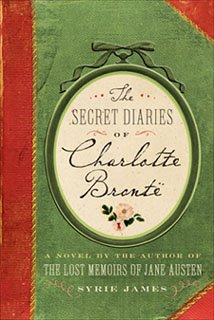
P.S. Look for Syrie’s The Secret Diaries of Charlotte Bronte on sale 6/30/09

The Pleasures of Lab and Coyote

I’ve had three dogs in my life. A Doxie when I was young. A Saluki when we bought our first house with a yard. And Cinder, the wise and ancient Labrador that is my constant companion. I’ve loved them all, but I’ve made it known to anyone who’ll listen, that this is it. I’d like to be dogless for awhile after Cinder, well, after…

My first canine: Taffy. The Dachshund was my dad’s choice for an animal. I wanted a puppy who was covered in soft fur all over, someone like Benji or a silky Cocker Spaniel. Needless to say, that wasn’t in the cards, but as most dogs have a way of winning you over, Taffotil won me. Eventually she became more my mother’s dog than mine–dogs attach to the one who feeds them–but I loved that scurry of hers across the kitchen floor–all that nails-on-linoleum enthusiasm.

Risuli was really Tim’s dog. He’d seen a Saluki somewhere and thought, “Now that’s a great looking canine.” Or something like that. My first impression was that this is a strange breed. Again though the animal won my heart. They have a way of doing that. One of my memories of the regal Risuli is the way he had of sneaking up behind people and just standing there, silent, watching. And when that person, say someone like the meter man, turned around and saw that dog, he beat it out the gate in 10 seconds flat.

Then came Cinder, who started off as Hillary’s dog, but eventually became my dog since possession is 9/10ths of the law. Cinder, named by Nick for a road off the 395 on our way to Mammoth was officially Cinder Phoenix Raisin Toyon. She’s around, 16 human years old, spending her winter days napping in my old pink sweater, a little blind, a little deaf, and still with the most enthusiastic tail in the continental US.

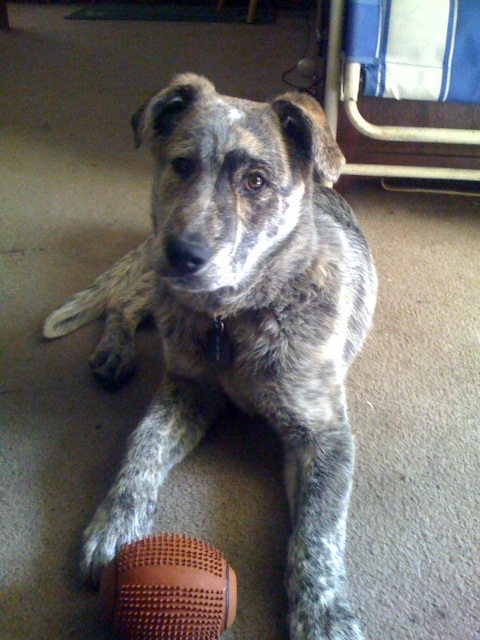
Rodeo is my daughter’s puppy and since she’s here, he’s here. And he is a kick. He’s a Reno shelter dog, a mutt with more coyote in him than Australia shepard, and at less than a year in age, he’s got energy that my lab finds, er, more than a little annoying. What I think Cinder resents most is the herding.

It’s funny to watch this happen, my 112 year-old-lab giving me a look like, “Mom, where did you come up with this animal?” as she obediently shuffles into her kennel. And Rodeo cocks his head, sniffs her butt, and seems to say something like “I thought you wanted to take a nap since you won’t play! I’m only trying to help!!”

Okay enough of that foolishness. If you catch sight of Rodeo as he disappears through a door, your mind flashes on feral-animal-in-thehouse, that slinky lope, that bristly tan fur, but if he’s coming at you with that cute little shepard face, ears perked up, blender-strewn splotches of browns and tans, and that grin, well, your heart melts.

He’s a good dog. Totally housebroken with just a little too much fondness for sprinkler hoses and the lower branches of camellia bushes. I took him for a walk and found I was much more patient with him than I ever was with Cinder, walking her with a twelve and ten year old in tow, both arguing about who’d get to hold the leash next. Rodeo did well. Listened to my sits, sat up straight, took off on the heel. It was exhilerating, but with all that, I still won’t get another dog. At least for a while, although those standard poodles I’ve been seeing around are pretty cool.