Category Archives: writer

JOURNEY TO PLANET WRITE: Treading Water Even in the Dryer Seasons

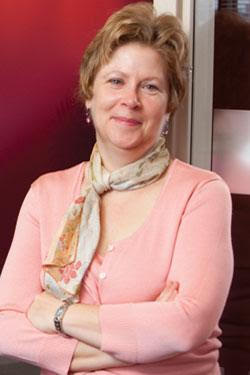
by Jane Rosenberg LaForge 
No matter where I am, people ask me for directions. I could be in New York, where I have lived for 18 years, or on the streets of Paris, where I have spent six days, and someone will approach me for help.  I rarely know, for I am a tourist even in my own city.  But I must look as though I have a terrific sense of direction. Or perhaps I always appear to belong, or I’m someone who knows where she’s going and how to get there.
Cub reporters were once told they needed five years of experience to get a decent job.  I got mine at the Ocean City, Maryland, bureau of the Baltimore Sun. I was the only employee of said bureau, i.e. a desk I fashioned out of motel-style end tables in my rented living room. Ocean City was laid out like an aircraft carrier: one long strip of cement. The streets were numbered and reached into the hundreds, so no one asked me for directions. You could drive in circles and find your destination. Among my many scoops was the story of a kid who drove very fast and backward in a parking lot one night. He was “doing donuts,” and drove himself into the ocean.
There was a drought that summer; the mainstream media was trafficking in the term “global warming” for the first time. Temperatures at the beach hit the 90s. I had brought my relatively new husband with me, which meant he was unemployed while I was on duty. We argued a lot about how I neglected him to I chase after fires, drunken boating accidents, and an NAACP boycott of the town.  Hotels, restaurants, and amusement parks would not hire townies, a.k.a. African-American kids who lived on the mainland. Across the drawbridge, their roads were not always paved, and their access to public sewage systems not guaranteed. It was territory the Industrial Revolution and the Civil Rights movement apparently forgot, which made great copy for me, but a lot of misery for everyone else.   
I was crossing a field of corn on a dirt road on an inky night when my car was either attacked or ran into some indeterminate yet vengeful force. It slammed against the windshield and the passenger-side door so fiercely I had to stop driving.  When I dared to look through the windshield, I saw it was the only thing preventing me from drowning. Perhaps it was a flash flood, or that global warming business had reached critical mass, and the ocean was cresting into farmland. Or this was some kind of a test, a trial by water with a blindfold that also covered my common sense.
I realized through my disorientation and panic that the field, unlike most, was irrigated. I had hit a bank of water because the system had switched on.  My job was a kind of trial too, to see if I worthy enough to transfer permanently to the Metropolitan desk. And right then, I knew the trial was over, and I’d lost. I knew because I would have rather been lost, under water and mud logged, than on my feet and on my way back to whatever I was working on. I wanted to savor this experience and mine it for its potential symbolism. It held more possibility and portent than all that transpired that summer, because I could make it mythic.
Indeed, I was demoted that December, and went onto other nowhere-newspaper jobs. I got divorced and enrolled in an MFA program. In my first year, I built a story around my watery encounter into the tale of a boy who thinks he got his skanky babysitter pregnant (waters of birth, a new beginning, etc.). Though it was not the most coherent story ever written, I had wrestled it out of my own ephemera. I won a fellowship for older women writers, and resolved to learn all of the shortcuts in the rural, suburban, and forested sprawl that surrounded the campus.  
Soon enough, I was assigned an instructor convinced I was an insult to the intelligence of all sentient beings. I’m sure others have had this experience, but she amplified the humiliation she doled out during workshop by confiding to others how ardently she disapproved of me. Because one of my thesis committee members had heart surgery scheduled for the day of my defense, I had to include her on my committee. I managed to graduate (re-marry, move, and have a child) but found myself unable to write for many years afterward. When I had any doubts, I had her voice reminding me how I should indulge them.
I have since published a memoir; four volumes of poetry; and am in the midst of working on two others scheduled for publication. But I can barely navigate the grid system of Manhattan, though isn’t that what subways and a New York native for a daughter are for? I recently was relieved of a freelancing gig. The editor disagreed with my interpretation of the myth of Prometheus, whose theft of fire from Zeus – the equivalent of writing – earned him a lifetime of suffering. I can’t find an agent for my new novel, though one agent said in rejecting it: “Your writing is beautiful, and many of your sentences are so gorgeously crafted. You have a lot of writing talent,” and if I kept working on my craft, some day “you’re really going to knock our socks off.” I wonder if she knows I qualify for Social Security.

It’s been my failures that have defined my journey as a writer. The only thing certain is there will be more of them. Yeah, yeah, yeah, I know about Samuel Beckett and “failing better.” At this point, it could be mathematically proven that this maxim doesn’t apply to my case. I don’t particularly like Beckett, but I think he’s onto something about how bleak our alternatives become if we do nothing in the face of inevitability. If I don’t know why I subject myself to ever more monstrous failures, I need only look at the settings of his plays to see what awaits me should I quit. I am a lost soul who cannot help but look for meaning in my life.  I’m headed where everyone is going, but I hope to take my time, and take notice, before I get there.
For her website: Jane Rosenberg LaForge
For the new chapbook, In Remembrance of the Life
Facebook author page: Jane Rosenberg LaForge
Twitter: @JaneRLaForge
______________________________
  
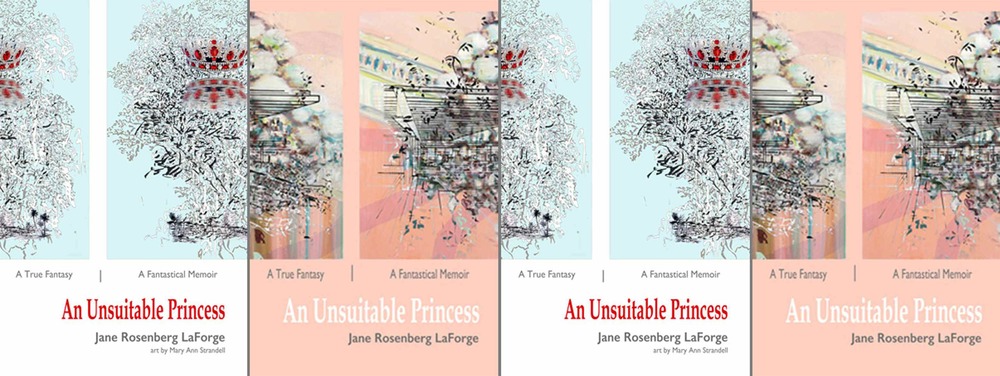
Jane Rosenberg LaForge is the author of An Unsuitable Princess: A True Fantasy/A Fantastical Memoir (Jaded Ibis Press 2014) and four volumes of poetry: After Voices (Burning River 2009); Half-Life (Big Table Publishing 2011); With Apologies to Mick Jagger, Other Gods, and All Women (The Aldrich Press 2012) and The Navigation of Loss (Red Ochre Lit 2012). Her newest poetry collection is the chapbook In Remembrance of the Life (Spruce Alley Press 2016) and her full-length collection, Daphne and Her Discontents, is forthcoming from Ravenna Press.

SaveSave
JOURNEY TO PLANET WRITE: Channeling Benjamin-The Data Made Me Do It

by Linda Wastila
On January 2, 2016, I marked my ten-year anniversary ofwriting. How do I recall so clearly when I began writing? And, after a decade of pen to paper, much of it devoted to two-and-a-half novels that remain unpublished, why do I even bother?
Let’s back up. By day, I’m a scientist, first trained as a pharmacist in the bucolic kingdom of Chapel Hill. I started down the pharmacy path as a means to medical school but discovered I didn’t want to deal with warts, ear infections, and patients’ poor lifestyle choices. I turned to public health, where I learned a lot, including the sad fact that after five years of an undergraduate curriculum studded with science classes and multiple choice exams, I didn’t know how to string together a sentence. My thesis advisor mandated I get a writing tutor. Which I did.
My first job was at a Boston think tank. My office overlooked the entrance to the emergency room at New England Medical Center. It was loud, distracting, fascinating existence. There, I wrote nothing you’d be interested in: passive voice, peer-reviewed manuscripts filled with science jargon. Shortly into my first gig, I realized I wanted to run my own studies, which meant I needed a Piled Higher and Deeper. I returned to another bucolic campus—Brandeis University. It was there I fell in love with… numbers.
Fast forward to Baltimore, 2005. As a Research Professor at the University of Maryland, my job was to grow our department’s research endeavor. My salary was 100% covered by me. Which meant a LOT of grant writing. Fortunately, I was good at grant writing and had several studies, almost all involving gigabytes of data that required massage and analysis using sexy techniques like negative binomial regression. But I acquired one unusual project that required me to look both back in time and into the future regarding psychiatric medication development. The study required both analysis and reading about drug discovery, theories on illness manifestation, and how chemicals alter psychiatric maladies.
I read at night, crunched numbers by day. One afternoon, while studying data on health care costs among mentally ill people, I noticed several individual points scattered far from the bulk of the others. The outliers. And it occurred to me, for the first time, that those data points were people. Real people. Individuals with serious and expensive mental and physical health problems. Which made me ponder those dots of data, ponderings that didn’t make themselves known to me until…
I woke up one morning and my first thought was, “Who is Benjamin Michael Taylor and why is he in trouble?”
I got out of bed, went to my computer, and wrote a short, incoherent paragraph about Benjamin. I shut the file, went to work, and forgot about him.
Until six months later when, in the weeks between Thanksgiving and Christmas, I stumbled across the file I’d named ‘benmich’. As I read my notes, his entire story tumbled before me.
Benjamin consumed me during the holidays—What did he look like? Did he believe in God? What music did he listen to? I didn’t know what to do with the information. I believed myself mad—crazy mad—because Benjamin became an obsession: I saw him in the streets, I dreamt about his tattoo, I woke at night and worried about him locked up in the loony bin.
On January 2, 2006, after not listing ‘writing a book’ on my list of New Year’s resolutions, I began to type out the words stuck in my head. At first, I wrote tentatively—what if I got stuck? What if my words sounded ridiculous? But the writing came easily—I was in ‘flow’—and continued until I finished Ben’s story five months and 183,000 words later.
During those five months, it felt as though I was a medium and someone else channeled words through my hands onto the keyboard and onto the screen. I worried my protagonist and I shared a common malady—bipolar disorder. What else explained my extreme focus and productivity? Much later, I found out frenzied writing is a medical condition called hypergraphia, a compulsion to write. An incredibly heady and empowering experience. I believe if my first foray into writing had been ponderous and tedious whether I’d still be at it because, as I’ve since discovered, writing IS hard. Damn hard.
I continue to spend every morning, often in the dark, writing for 30-40 minutes before my family wakes and the day swallows me. I pluck away minute by minute, word by word, because in those blessed hypergraphic months I discovered I love the journey of creating with words almost more than the creation itself.
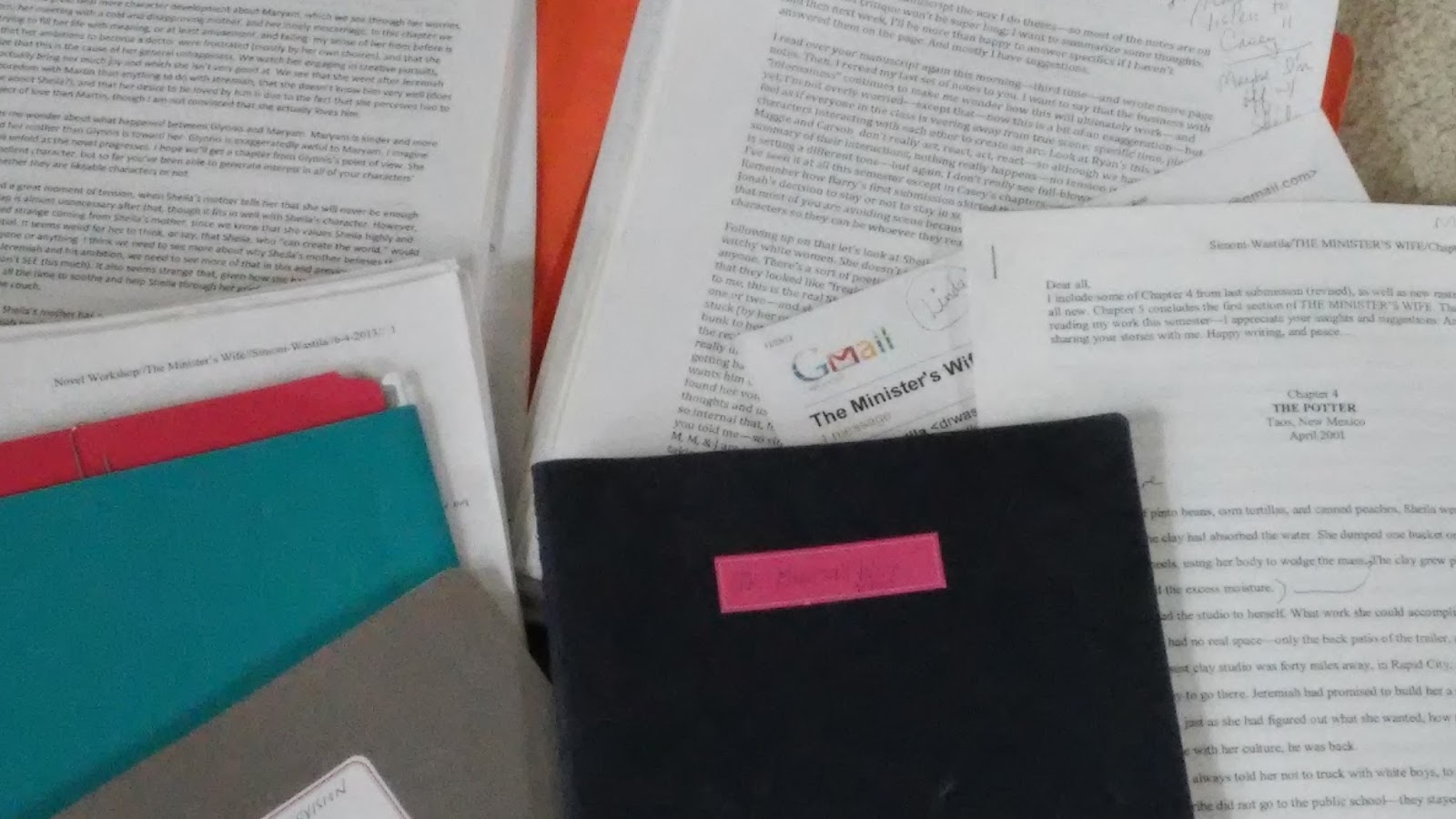
Ten years later, my sad-lad literary creation BRIGHTER THAN BRIGHT is exactly half as long as the first draft. I’ve continued Benjamin’s adventures in PURE, a novel of academic malfeasance. I’m marketing my novels in hopes of finding a sympathetic agent or editor who wishes to help me launch my babies into the world. My third novel, THE MINISTER’S WIFE, started three years ago for my Master’s thesis, remains a glorious mess.
As it should be—novels are beasts. And it’s this challenge—and pleasure—that compel me to write.
In the end, data drove me to write. I wrote what “I knew” and discovered the people behind the data points have stories to tell. So I try to tell them. Over the decade, these problems have become personal, affecting friends and family, but these experiences only fuel my need to write their stories, to bring to light my take on my world.  
_____________________________________


LJ Wastila writes from Baltimore, where she professes, mothers, and gives a damn. Her Pushcart- and Best-of-the-Net stories and poems have been published at Smokelong Quarterly, Monkeybicycle, Flash Frontier, Scissors and Spackle, MiCrow, The Sun, Blue Five Notebook, The Poet’s Market 2013, Hoot, Camroc Press Review, Every Day Fiction, and Nanoism, among others. In 2015, she received her MA in Writing from Johns Hopkins. She currently serves as Senior Fiction Editor at jmww. In between sentences, she blogs at Leftbrainwrite.

JOURNEY TO PLANET WRITE: Why I Felt Jealous of a Twelve-Year-Old

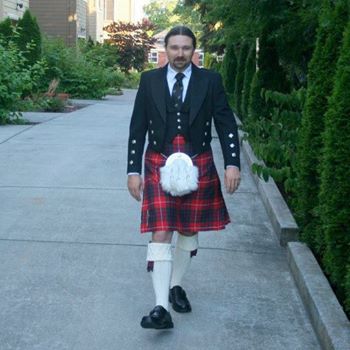
by Sam Snoek-Brown


I knew almost as soon as I could write that I would become a writer. In my childhood, I put a schedule on my door insisting on undisturbed writing time each day. I had my parents custom-build a desk into the nook of my closet, with a small bookshelf installed above it, a gooseneck lamp, a door I could close—barely into a double-digit age, I had my own writing space. I wrote my first book by age twelve, won writing contests, and had only to wait for success to find me.
None of that is true. Or, it is true, but not of me. Working for a city newspaper during my college years in Texas, I was assigned to report on the local library’s youth writing competition, and all those wonderful, writerly details—the schedule, the desk in the closet, the book, the ambition—are from the profile I wrote about the young girl who won that year.
In my actual story, my parents gave me a desk, but I used my pencils and ballpoint pens to stipple the surface until it looked less like wood than like pumice. In second grade, I spent hours alone in my room writing pages and pages of material, but it wasn’t creative—my mother got tired of forbidding me my misadventures and told me to copy the definition of “No” 100 times, unaware that “No” comprised a full three pages in our family dictionary, two columns each page, in tiny print. I didn’t write a book by age twelve, but I did invent lyrics to absurdist songs about defecation and once adapted “On Top of Spaghetti” as a bawdy sex lyric.

In other words, I wasn’t born to be a writer. Or at least, I didn’t behave like one when I was a kid. My father wrote scathing editorials and short satirical pieces, my paternal grandfather was a natural storyteller full of a ship captain’s sea yarns, my maternal grandmother was a closet memoirist—but I was just a kid. There was nothing magical about my upbringing, no prophetic sign that I would take up the pen and the keyboard and become a writer.

Though there was my seventh-grade English class.
My middle school had begun a program of weekly “sustained silent reading” periods, and my English teacher, Mrs. Hoffmann, added a second period of “sustained silent writing.” We were allowed to write whatever we wanted—journal entries, rap lyrics, love poems—and I decided to write a novel.
I’d been reading a lot of my father’s action novels and was just beginning to discover Stephen King, and I realized that when I tried to predict what might happen next in whatever novel I was reading, I wasn’t hoping to decipher the story, I was wishing the story had gone differently—I was inventing stories of my own. I was rewriting stories as I wanted to read them. And right around the time I began to think that if Don Pendleton could knock out half a dozen Mack Bolan/The Executioner novels every year and sell millions of books, then surely I could, too, my English teacher gave me the gift of designated, disciplined writing time.
My first novel was about a teenager whose parents were killed by an evil crime boss surrounded by ninjas; in his sorrow and anger, the teenager devotes himself to martial arts and fights his way through the ranks of minions to confront the crime boss.
I eventually gave up on that novel, but Mrs. Hoffmann—who, after school, had become my first writing mentor—insisted I keep telling stories. My father signed me up for a writing workshop on how to publish (neither of us knew until I arrived that the workshop was for romance novelists, but I eagerly took notes on plot outlines and novel advances). I developed a sci-fi series about an alien race and invented a religion and a language. I began writing horror, stories about necrophiliacs and occult serial killers and mutated warriors held prisoner by secretive government agencies. I found Anne Rice and spent most of high school and college toiling over a melodramatic vampire novel.
Which is to say that by the time I wrote that newspaper article on the young library contest winner, I already was a writer. Yet I still hesitated to call myself one, and I marveled at this kid living a literary life I still felt outside of.
When I started that novel back in middle school, I began imagining the origin story for my writing career—publication as a teenager, phenom status, appearances on talk shows—and ten years later, working on that article about the kid writer, I began to wonder if I’d missed my chance. My origin story was too long delayed. I had wasted all those years poking holes in my writing desk and making up feces songs instead of becoming the writer I dreamed I ought to be.
In some parallel universe, there is a version of me that did publish as a teen and go on talk shows. He is telling the origin story I wrote for him decades ago. In another universe, there is a version of me who has never published. He is still concocting new origin stories, new fantasies. They will go into a password-protected file where no one will read them except that other Sam, late at night, only the computer screen and his fantasies alight in empty room.  In yet another universe—this one—there is me, many writerly milestones behind me but still sending ahead invented milestones to reach for (an advance on a book deal, film rights, career stability). And here I am, revising my childhood origin story, realizing that I started out as a writer in exactly the way I ought to: by daydreaming, by writing the stories I wanted to read, by crafting the story of myself, by always trying to make it a better story.

_________________________________________


Samuel Snoek-Brown teaches writing in the Pacific Northwest. His work has appeared in dozens of literary journals, and he serves as production editor for Jersey Devil Press. He’s the author of the chapbooks Box Cutters (sunnyoutside 2013) and the forthcoming Where There Is Ruin (Red Bird Chapbooks 2016), the forthcoming novella In the Pulse There Lies Conviction (Blue Skirt Press 2016), and the historical novel Hagridden (Columbus Press 2014), for which he received a 2013 Oregon Literary Fellowship. He is online on Facebook, Twitter, and at snoekbrown.com.

JOURNEY TO PLANET WRITE: Life Writes Itself

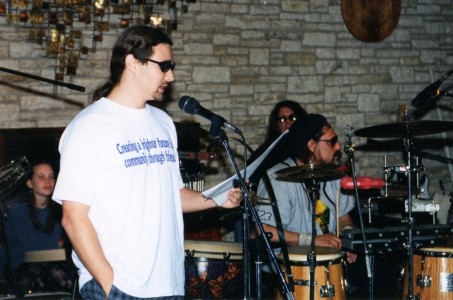
by Levi Andrew Noe

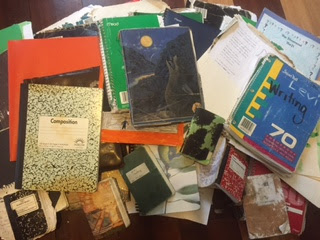
Most of my collected notebooks from age 7-27


It all started in kindergarten with my breakthrough story “The Bose Busbros,” (The Bossy Brothers).  It was my first typed draft of a semi-autobiographical tale. It chronicled a young boy whose elder brothers refused his right to hot chocolate and sent him to his room.


You could say I was always a writer. From the moment I learned how to shape words into somewhat cohesive sentences, I was telling tales, filling notebooks, and frustrating teachers with my illegible handwriting.

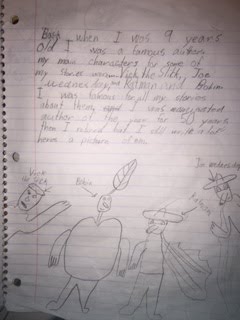
I haven’t deviated much from my hopes and dreams as a 9-year-old, as recorded in the notebook entry below left. Though experience has taught me those lovely lessons like cynicism, world-weariness, and the plight of the starving artist, my deepest hopes still place me as a would be “famous author.” I abandoned the visual arts, however, just after elementary school.

Middle school served to squash most of my passions and creative pursuits, as public school and puberty are so infamous for achieving. But in high school a new art form sowed its seeds in me: music. I was in a couple bands including pop punk, emo and/or hardcore, called Knester, Sell Out Boy, and A Call to Arms.  As arrhythmic and cacophonous as it was, in music the spark of artistic creation was again re-ignited and reimagined.

I was the bass player and backup screamer in A Call to Arms. We played house shows, dingy cafes and friends’ birthday parties. We were terrible, beyond offensively awful, but we played our angsty hearts out. Through music a new writing style emerged for me in the form of poetry. It was not my calling to play music, but music fuels, inspires, and moves me deeply, and I believe it permeates my writing to this day.

My college years came and I continued to grow, both as a writer and person. In those formative times I dove into academic writing right alongside dumpsters, beer bongs, and the bohemian lifestyle. Through it all, I found a deep affinity for every genre of writing. I graduated with a B.A. in English Writing and a minor in Holistic Health, but not before I took a semester off to hitchhike up and down the West Coast, sleep in bushes on the side of the road, and spend a few month at a yoga community in the redwoods of California.

It was those days, my wandering, unrestrained, wide-eyed early twenties in a perpetual existential crisis that formed the bedrock of who I am today, in my writing and in my personal philosophy. Post college, I continued in my voyage of discovery, but in a slightly more responsible way. I spent a summer in Ketchikan, Alaska working at a coffee shop, teaching yoga, picking berries, catching salmon and writing all the while. The jaw-dropping, infinitely astounding natural world is still probably the greatest muse for my writing.

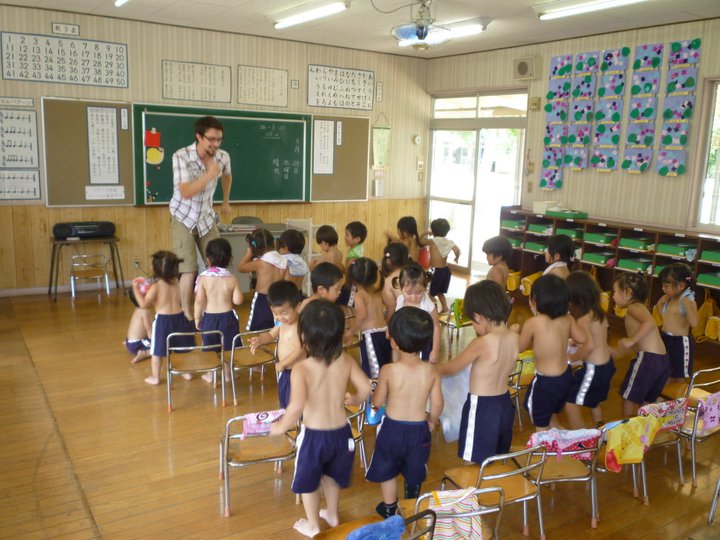
In 2011, just after the great earthquake and tsunami hit Japan, I decided it was a good ideato go teach English there, just about 150 miles from Fukushima. Japan is a place so full of wonder and weirdness, tradition and contradiction. It certainly inspired a new era of writing for me. I began my first novel (still unfinished), as well as many pieces of every genre which I have placed into various manuscript collections (waiting for their time), and there I continued and deepened my love affair with haiku.

Following teaching in Japan, I took the long way home. I traveled through southern Japan, then flew to Bangkok, Thailand. By train, bus, van, boat, tuk-tuk, and motorbike, I made the loop through Thailand, Laos, and Cambodia. I spent a few months in SE Asia and it was no big deal, just totally changed me forever and was one of the most important periods of time in my life thus far.  Then I spent 1 ½ months in India, got my yoga certification in Rishikesh, swam in the Ganges (the clean(er) part), and saw about one thousandth of what I wanted to see of the Himalayas. Needless to say, this period of my life carved its story through every aspect of my being.

But home’s call is always strongest, and always pulls at the heart the hardest. I returned to Denver, Colorado as a new, worldly-wise, battle hardened, adult(ish) person.  I came with goals, with plans, with a new perspective, and some sense of what I came here to do in this life.

Since 2013 I have started and liquidated four businesses and conceived of dozens of others, one is still currently running and semi-viable. This business is Tall Tales Yoga, the merging of my three greatest passions, teaching yoga to children through storytelling. In addition, I have self-published four children’s books, and had a couple dozen short stories, poems, articles, flash fiction, creative non-fiction pieces published. I started the podcast Rocky Mountain Revival as another merging of some of my greatest loves: literature, music, and podcasts. To top it off, I’ll be getting married in July to a woman who is as perfect as any creature on this earth can be.

Life has had its ups and downs, but through it all, writing has always been my salvation, my torment, my obsession, and the most constant of all my psychoses. So, now that I think about i. Life has been pretty good to me, though I don’t always feel that way or appreciate the opportunities and experiences I have been given. I still don’t feel like I’ve “made it,” whatever that means. But I’m blessed in my own relative ways. And whether or not I become a famous author, a wealthy entrepreneur, or a successful human being, at least I can say I’ve done some shit, and I’ve given it my damnedest. Thirty might feel like a long life subjectively, but I know what those elder and wiser than me would say: “You don’t know shit yet.”


____________________________________


Levi Andrew Noe was born and raised in Denver, CO. He is a writer, a yogi, an entrepreneur, and an amateur oneironaut. Levi won first prize in 2011 and 2013 in Spirit First’s international poetry competition. His most recent or forthcoming works are in Ink, Sweat & Tears, Connotation Press, Boston Literary Magazine, Crack the Spine, Eunoia Review, Scrutiny Journal, and many others. He is the editor in chief and founder of the podcast Rocky Mountain Revival, Audio Art Journal.
Twitter: @LeviAndrewNoe, @RockyMtnRevival

Stroking the Details to Deepen the Story

Reprinted from Flash Fiction Chronicles article dated January, 2011

One of the comments that is difficult for many of us to come to grips with is when someone tells us our stories are not deep enough or that we haven’t given the reader enough to go on. I used to think: we’re talking flash here, micro flash, hint fiction, short shorts!  How am I supposed to “go deep?”
But for something to resonate, it must have context.  Readers want to feel empathy with the main character—or some kind of emotion for the main character—even if it’s distaste.  The question is, how does a writer do that with a limited word count?
Details not only set up time and place, but also suggest a back story, the circumstances, or even a trait or two of the main characters.  Specific details also anchor the story for the reader, giving them something to visualize while reading on to find out what happens next. Context and empathy come about through concrete, specific details that immerse the reader in the writer’s world.
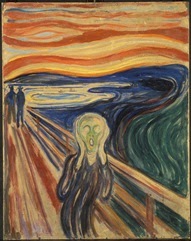
A lake and two small boats give
context to Munch’s painting

I’m not suggesting there’s any need to describe an entire room or tell the reader the exact time of day, but rather to stroke in a detail much as a painter might do.  If you examine a painting closely, you may discover that the person in the background is just a line squiggle with a touch of brown at the top to suggest hair and a swish of red to suggest a skirt or as in Munch’s The Scream: two small boats in lake.

The man screaming in the foreground of the Munch painting is alone while behind him there are two figures on the road and two boats on the lake.  I have no idea what the artist had in mind, but for me, this structure and detail suggests a strong fear of facing the world alone or facing death and because these details are behind him, he has no hope.

These details do not need to be written into a piece immediately in the rough draft–get the story down first–but can be added in the revision stage of the process once the writer understands what details will best serve the story in a thematic way

So detail, if carefully chosen, can suggest setting, foreshadow events (remember Chekov’s gun), as well as deepen character, and underline theme.

Here’s an example:

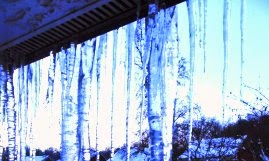
Water drips from icicles outside the kitchen window. Clear skies glisten through dirty glass panes. I’m pouring my first cup of coffee when I hear snow sliding down the roof and know it’s time to call Carissa.

This image sets scene as well as mood

This is the opening to my story, “Spring Melt.” It’s a stroke like a painter’s stroke.  The whole house isn’t  given, not even a whole kitchen,  just the suggestion of a house because it has a kitchen, dirty window panes, and a sloping roof.  There is a sense that winter is passing into spring and that brings the narrator to a decision to call some woman. It’s a specific image to carry the reader into the next paragraph, but also to give the story context and later, a thematic pay-off.

Details should be as carefully chosen as anything else in a story.  Which will enhance the character and hint about what could happen next? Physical appearance often dictates personality.  A woman who has always been admired for her beauty may never feel compelled to grow artistically or intellectually, and therefore has little to talk about except hairstyles and Botox. This narrowed point-of-view could, in turn, bring conflict to a piece about marriage or best friends or wherever the writer wants to go.  

Showing tension between characters through dialogue becomes easier when there is a trait or detail in the story that sparks deep feelings.  Here’s a brief exchange between Anna and Matt from “She Can’t Say No” to show how this can work.


…Alone at the table, Matt asks Anna how she knows his friend, Kerrick, a fast-track kind of guy, gel in his hair and Hugo Boss shoes.  

“I met him once,” she says and smiles. When she smiles, the scar on her upper lip whitens. Sometimes when he wakes up alone in the morning, thinking of her, the word “harelip” pops into his brain. He’s hinted to her about childhood operations, bringing up tonsillectomies, appendectomies, avoiding the words “quadrilateral mirault flap,” but she says nothing.  

Looking at her mouth now, he can almost feel its slight ridge on his tongue. He coughs. “And?”  

And what, Matthew?”  

“You were flirting.”  

“I know.” She slips the side of her naked foot along Matt’s calf and tucks it behind his knee. “I’m sorry.”


People in stories don’t always have to agree and when they don’t, they argue, and when they argue, they bring up old grudges, other disagreements, and reveal who they are and what’s important to them.  In the example above, the relationship between the two characters is revealed by how Anna parries Matt’s jealousy.  It’s not a fight, but it’s still a moment of revelation.  Then Matt remembers how it feels to run his tongue along the scar on Anna’s mouth telling us that although he is jealous of her past with men, he’s also aware of her affect on him. The detail of her scar makes this scene more interesting and deepens the emotional risk for both characters.

Sometimes a story may work without specific detail, but going deeper can often be as easy as changing a word or two, adding a line, using a bit of dialogue, or throwing in a specific detail that gives the reader context for the unfolding events like Anna’s slipping her naked foot behind Matt’s knee. She has the power and he knows it.

Flash Fiction Blog Launched

The last couple weeks have been loaded with things to do, launching the new Flash Fiction Blog for Every Day Fiction, finishing up a long short story , and turning…one more year young. But the new blog has had most of my attention.

I’m such a fan of Jordan Lapp, Camille Gooderham Campbell, and Steven Smethurst who are the brains, beauty, and brawn behind the innovative e-zine Every Day Fiction. Not only do they supply a new story every single day without fail to their readers, they offer a community for writers and readers alike and constantly stay relevant.

Their mission is to maintain “a magazine that specializes in bringing you fine fiction in bite-size doses. Every day, we publish a new short story of 1000 words or fewer that can be read during your lunch hour, on transit, or even over breakfast” and this is exactly what they do.

Additionally EDF sponsors a forum at their website that gives writers and readers opportunities to exchange ideas, learn more about writing itself, and form friendships and support groups. The forum is home to a writing group that is private so writers can post drafts of their work for imput from other writers. Anyone can join, but the posts are not public so they can be then submitted to various venues.

Recently they launched Every Day Poets to give writers and readers of verse the same opportunities to produce and enjoy verse.

And now there is EDF’s Flash Fiction Blog where writers can post their thoughts about the art and craft of writing flash fiction. This exciting new venue lets fans of EDF writers read about the trials and tribulations of their favorite authors as well as giving fellow writers the opportunity read and share with their peers. Check it out soon and click on “Submit a Post” if you have something to say, whether you are published or not, whether you are a writer or reader, all ideas are welcome as long as they involve the writing and reading of FLASH.

If you have any questions for the editor, that’s me, and you can contact me at flashfictionblog@everydayfiction.com .

More EDF good news and a lesson learned from whittling

MY heart still hip-hops into my throat when I open my Yahoo account and see on the
“From” line of an email, the words “everyone@everydayfiction.com.”

It’s the line that appears when they are sending a rejection, an acceptance…or actually maybe a rewrite. Any which way, I always take a moment before I open it. If I prayed, I guess you’d say that’s what I’m doing. Luckily for me, they like my “Stranger on the Porch” bit and are going to publish it sometime in the future. Hooray!

This is actually a piece I’ve adapted from my novel. As I’ve said before, I’ve been struggling to keep the seat of my pants in the chair. When I’m doing one thing, I’m often distracted by another. In this case, the idea of writing a 1000 words has so much more appeal than rewriting 80,000 words. But I have resisted the lure of flash so far this month even though titles and ideas on how to make those titles work assault me at the sink, in the shower, on my walks. Then one day–mid-anguish/temptation–I had a revelation.

Since I use a dramatic arc in each chapter by opening with conflict, torturing my character, and finally having her take some action–the same dramatic arc that I use for a story as a whole–I wondered if I could cadge something from the novel to satisfy my need to send off a submission to EDF and thereby not get totally out of the world of my novel characters. Write flash but have it benefit the novel too. Maybe chapter 1?

I took a look. Yep the arc was there, but I’d have to whittle it down to fit the 1000 word criterion. Wow. An amazing thing happened during this process.

Because I wanted to flash the chapter, I brought to it a much more critical eye, and suddenly realized how much better it was turning out. The whole experience reinforced my belief that parameters create in a writer the ability to dig deep and come up with something better than if there are no parameters.

What happens in this first chapter of my novel is not straight forward, and I’ve often changed it, edited it, played with it. But this time I knew I had to achieve more clarity for it to stand on its own as flash. The images became sharper, the character more interesting. Whittling worked again. What an incredible lesson I keep learning over and over.

Now my hope is that people like it. That it stands on its own. I hope it’s as good for you guys as it was for me.

Another Lesson From Reality TV: Emulate those who succeed

Project Runway is my absolute favorite reality show. Although my other favorites feature real talent and creativity, PR features the kind of creativity that I relate to. Not saying I could do what they do anymore than I can sing or dance. I can’t sew anything but a curtain panel, but I’m talking about deeper stuff, that digging into the hidden corners of the right brain when doing art and finding originality. That’s what two designers were able to do on last night’s premier of Project Runway, Season 5.

What is originality? Talent and imagination, certainly, but also a third component, knowing what to do with it. One could say a person either is talented or not, has imagination or doesn’t, but I don’t believe that. Like everything else in our genes, the amount of talent and imagination varies, but of more consequence is what we do with what we have. Last night’s first episode of PR is a good example of what I mean. There is talent and imagination in each contestant, but two of them also showed that third component: savvy, the wisdom and shrewdness to pay attention to those who succeeded rather than to those who failed.

I can’t remember their names, Blond Tattoo Girl and Wistful Guy is what I’ll call them here. BTG and WG are obviously students of the show and so were familiar with last night’s challenge: Season 1’s grocery store outfit, and they were successful because they looked to the winner of that challenge while everyone else focused on what previous contestants had done wrong. That shift of perspective last night made all the difference.

Here’s the set-up. The contestants were taken to a grocery store and given $75.00 to purchase materials to fashion an outfit. Tim Gunn told them to think about the WOW factor, to come up with something that would “blow the judges’ socks off.” Austin Scarlett, the competitor who WON this challenge four years ago, pointed out that he succeeded by delivering the unexpected. The name of that episode was “Innovation” and his design, a bustier sundress made of corn husks, transformed an ordinary agricultural product into a snazzy little summer number. Yet despite these admonishments, many of the contestants headed straight for the easy-way-out aisle.

The most obvious and forgiving “materials” to purchase are, of course, trashbags, shower curtains, and table cloths. My immediate thought as they scurried into the aisles to buy these exact items was “These guys have thought about this challenge.” Of course they have. Me too. Everytime I take onions and avocados out of their plastic netted bags I think ‘evening gown yoke.’ But unfortunately, this year’s designers focused on the contestants who floundered with seemingly unsewable products, and they were determined not to fall into the same trap.

All except Blond Tattoo Girl and Wistful Guy. They paid attention to the winner of that challenge. They recognized Austin’s inventiveness and had considered about how they too could innovate. WG made probably one of the most impossible choices. He bought plastic drinking cups. As one of the judges said, “Exactly what ANYONE would hurry to grab for this challenge.” But it worked. He molded–literally with an iron–a corset top and bell skirt that looked wearable and was definitely sexy. He remembered the word “innovation” and by the silhouette he chose, he also remembered the corn-husk design. He kept it simple and pretty, AND used the unusable.

This worked for BTG, too, who won the challenge. SHE was crazy-creative with her vaccuum cleaner bags, her coffee filters, her tacks, and her binder spirals. Again I’m positive she’s thought about it before the show, asked herself, “What would I do if…” Her dye and bleach treatment to the bags created a fresh and artistic skirt. The burn-out filters worked humorously with the tacks for the bodice. It was charming. I was pleased she won.

So why am I–a writer–spending all this time on this topic? Because this first episode of the season carries with it a potent message: emulate those who succeed, not those who lose.

How many times has a writer, a friend, or even me, said, “I read the worst book. I know what’s wrong with it, so I know what not to do!”

Is this what any creative person should think about? An artist? A designer? A writer? Or should he or she instead, study what’s hanging on the walls of the Norton Simon and MOOLA? Watch what’s coming down the runway at Olypus Fashion Week? Or read closely for the content, the structure, the language of To Kill a Mockingbird or The Yiddish Policeman’s Union or Tess of the D’Urbevilles and shout out loud, “Now this is the kind of art I want to do!”

The two best pieces last night were created by savvy designers who listened, who studied the winners, who dug to the center of their imaginations, and who executed with confidence and verve. That’s the kind of writer I want to be. An original.

Not Knowing Shouldn’t Keep Me from Not Doing

“The single largest advantage a veteran writer has over the beginner is this tolerance for not knowing.” –Ron Carlson from Ron Carlson Writes a Story.

It’s funny how I’ll read a book about writing or even just a piece of literature and then I go on and on about it for days. This time it’s Ron Carlson. Last week he helped me write a whole story which I’ve submitted to Flash Fiction On-line, a new venue for me. And this week he’s helping me stay in the chair for my novel. I’m bolstering that with keeping track of the time in the chair and how much I accomplish. I started work at 9:13 this morning. BTW, I shouldn’t be typing this right now. I’ve now been distracted for about 10 minutes! Dang, and it’s 10:08 AM. That means I managed to work less than an hour before I figured out a way to goof off. Back to WCB. It’s now 10:09.

It’s 4:28 and I’m three chapters in having done more editing than I would have thought. But I’ve learned a lot writing my flashes this year about what I don’t have to say so I think these chapters are tighter and therefore, better. As for my seat of the pants in the chair, I haven’t been very good. I would be six chapters in if I’d just stayed the course. I tried to work outside away from the phone and internet but it’s been hot here today and the garage isn’t air conditioned so I gave up and came into the chill of the house where there is email and EDF forums to read, food, and HGTV. Yish.

But I am begun really this time. I have to keep up my momentum because I do not want to reread these chapters again until I’m finished. I taped a note on the fridge that says “Aren’t you sick of the first 125 pages and aren’t you curious to see what you wrote after that?” I’m gonna feed my dog now and maybe come back up for chapter 4. I’m going to hold myself accountable to YOU out there.

Okay. I did it. It’s 8:30 and Chapter 4 is in the vault. I’m feeling as if I’m in a rhythm now so hopefully tomorrow with be more of the same.