Category Archives: Uncategorized

Electric Boogaloo: Clairol’s contribution to my head

Like so many subscribers to the philosophy that “Today is the first day of the rest of my life,” one of the items on my New Year’s todo list is to clean up a drawer or cabinet or closet a day. Yesterday I pulled out my Clairol electric roller appliance. Can anyone help me figure out how old this thing is?
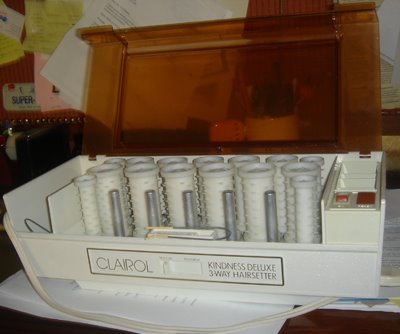
It’s missing a whole row of curlers. Those silver rods which heat them stare back at me like dental roots. If you’ve ever had a cap or root canal, you know what I’m talking about. The gaping hair appliance looks as if someone with a hammy fist smashed out Clairol’s teeth. Made me wonder where I might have left those rollers and when? And are they replaceable? Does Clairol still make this kind of thing?

Mostly seeing this piece of my personal history, makes me feel old. They became popular when I was in high school. Which means there was a time in my life when there was no such thing as electric rollers.

Of course, my mother did have a beautician give me a duck tail in the second grade. I felt humiliated, shorn of 95% of my hair, I felt like the proverbial ugly duckling and decided I would never have short hair again.

I started setting my mop in the fifth grade. My awareness of the other sex started around then and it became essential that I never appear at school with unkempt hair. Rollers in those days were round wire tubes with a brush inside and netting over them. I washed my hair every single night, set it in these French Revolution items of torture, capped my head with the plastic hood of a hair dryer and went to sleep too the drone of vanity. I did this every single night of my life until the invention of electric rollers.

I’m trying to remember all the different curlers in my life? The skinny plastic ones of my childhood to achieve the perfect (and still popular) Shirley Temple ringlets, the spongy foam ones that were comfortable to sleep in but gave my hair a flat lopsided look, and pin curls. Sometime in my life before rollers of any sort, there were bobby pins! How important it was that each little strand of hair was twisted in an exact circle. A sloppy job with pin curls led to taunts on the play ground. Ironically in high school, there was a time,long before it was ecologically correct, when I went in the opposite direction using coke cans instead of rollers.

But then, Clairol appeared on the scene with the perfect solution: electric rollers and I used them for years with only a brief four-year period in there when I ironed my hair to get it as straight as a nail.

I’m putting the rollers in a Salvation Army bag. I figure some collector out there will have extra rollers to fill in the gaps and will sell it on ebay for 20.00+40.00 for shipping.

Or maybe I’ll just shove it back into the cupboard, close the door, and forget about it. That way I can pretend that my younger self is still a round…at least a little bit.
Happy for Kate, What happened to Anne’s face, and I’ve got to stop goofing off

This will be brief. No writing lectures. I have too much to do.

BUT I did want to say I’m happy for Kate Winslet. Although I haven’t seen “The Reader” nor “Revolutionary Road,” I’m happy one of my favorites is finally getting the recognition she deserves.

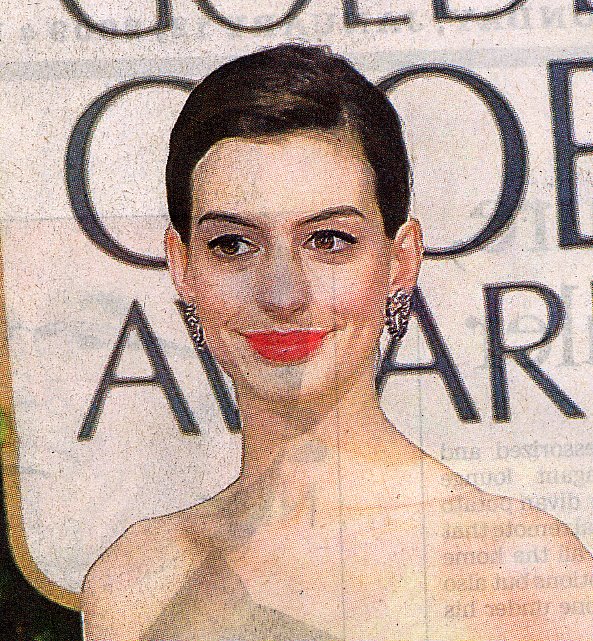
Just a quick remark on Anne Hathaway’s face in today’s LA Times. It looks like an illustration to me. Did someone over there photoshop her head?

And last of not least. I am disappointed in Outliers. I’m sorry I recommended it. Gladwell’s essay on success isn’t the tight, cohesive analysis of what creates success that I expected. However that said I’m happy he has reasserted that persistence is as essential as talent and that sometimes with a little talent and the right amount of practice, a person can arrive where she wants.

Conflict and Journey

Conflict in a story is the tension between a character and herself, a character and another character, a character and society, a character and nature, a character and the cosmos. Conflict creates situations (events) that cause the character to act and react.

It is what a character does in difficult situations that reveal who the character is, and therefore reveals the character’s humanity. The revelation of our humanity is what literature offers the reader. (Watch Tess of the D’Urbevilles on Masterpiece Classics if you want an excellent example of deep character revelation. Better: read the book by Thomas Hardy.)

The “journey” is really two journeys. the journey of the physical events of the story and the journey of a character’s soul.

It is the physical “journey” the character “goes on or through” during as she acts and reacts to the physical situations of the story. A story opens with events (the plot) and these events create the physical journey. And this is often enough in some genre stories.

But many genre writers and lit writers take their characters on an emotional/spiritual/self-revelation journey as well. The main character is established at the beginning as having a particular mindset or attitude, and who will realize the status quo no longer is possible and must reach inside to meet the challenges and either fail to do so (classic tragedy) or succeed (classic comedy) or many many points in between depending on what the writer decides to do. What changes the status quo can come from the inside of the character or from the outside, but it should set up a desire, want, need, mission, or state of mind which causes a conflict for the main character so that that character takes action until some kind of resolution is reached.

If the character has no obstacle standing in the way of her goal, need, want, challenge, then she will most likely stay on the couch with a bowl of jambalaya and watch Law and Order.

This look at basic structure is somewhat simplistic. There’s a lot more to it, but it is helpful to know that what stories do is reveal character through conflict.

This gives the writer a tool to use when rewriting so that she creates characters who will get off the couch. Unless, of course, that’s the story you are telling. Then the not-moving-off-the-couch is gonna be just perfect for creating tension between your character and her husband, her kids, her boss, her mother, her lover, the garbage man. How long can she hold out? What will she do to stay on the couch? How will she respond when they bring in the shrink, the priest, the fork-lift?

The journey is going from point a to point b.
The conflict is the car wreck on the way from point a to point b.

The Day Before a Brand New Year

I love the end of one year and the beginning of another. I suppose it’s because I’m a long time advocate of the aphorism “Today is the first day of the rest of your life.” I’m not sure where that comes from–probably a twelve-step program–but regardless, I embrace second chances, new opportunities, jumping into new frames of mind. If there is one thing I’ve learned is that my past doesn’t have to be my future. I know who said that, at least on a self-help tape, Tony Robbins and it resonates with me.

There is almost always something one can do to make things better, or to shift from one path to another. I admit I’m not sure this works for people in dire straits, the homeless, the destitute, the hopelessly addicted and those who have the misfortune to live where war rages, but the rest of us, we have no excuses.

I only have a vague idea of what I want to accomplish this year. I haven’t taken the time to write it all down yet, but I do know that while some of my resolutions may fall by the wayside, most of the will not. This is the year I want to keep things simple, take each day as it comes, but be clear to myself what is really important. I want to take steps everyday–creeping aching steps if necessary, but steps toward making my life what I want it to be. Keeping my family and friends close, keep my fingers at the keyboard daily for strong productive segments of time, painting often, and painting only what I want to paint with no one’s rules drumming in my head, and beading too, even that, when I want something I can hold in my hand immediately, feel its weight, and give away. And I want to do something for others. Step out of my own world for a while each week and give away something of me.

I count myself lucky that these are the threads I can braid together into a thick uneven plait and lucky to be able to shake it out at the end of each year and start again.

Process and Malcolm and Outliers

This morning I read an article about Malcolm Gladwell’s new book, Outliers and his theory that it takes 10,000 hours to become an expert. It’s confirmation of what I’ve told myself. Writing–good writing–is all about the seat of the pants in the seat of the chair. Thank you Mrs. Hawkins. So time spent becoming an expert means time spent in the process of doing.

I’m rereading Ron Carlson’s book, Ron Carlson Writes a Story, on process. I gave my original copy to Mr. Pierpont, a writer friend who lives in Seattle, and ordered a new one for myself. I love that book because Carlson lets me sit on his shoulder as he puts together his story.

When another friend shared with me this morning that she’s decided the best way for her to work is to begin by sitting down and letting it happen, it resonated. This is exactly what Carlson does. He says “process” is the key, finding your own, and I couldn’t agree more. Here’s mine.

1. I type or hand write everything I know about the idea in my head. I do what feels “right” as a first step, whether it’s a full-to-the-end draft, notes, outline, or brainstorm. This varies with the trigger, the dawning of an idea in my brain, what it is: a title, a plot, a character, an incident, a theme.

2. Whatever I end up with, I work from there.

If it’s mostly a plot, I make an informal outline, then I fill in the blanks, the who-what-where-why-how of each scene in the outline. I remind myself that scenes, scene-sequences, chapters, parts, the whole story, should have answers to all five questions somewhere in the text. I try to identify the possible theme here, but sometimes I have no idea.

If, instead of making an outline, I’ve written a draft to express what I know about my story, I search for the major scenes-segments-acts and ask myself what they mean thematically, what the spine might be etc. I also consider the order I’ve placed these scenes in. Does it make sense?

If I’ve come up with notes and brainstorming, and this is my most common way of proceeding, I write a quick draft. Sometimes I do a little research about the “where” or the “what” before I write that first draft, but often I just go.

3. If the story’s got something compelling, all the above converges and I have a working draft. Then it’s time for me to do some kind of analysis. These are the things I look at.

Character
Are characters clear, defined, and have their own problems and attitudes? Do they fulfill a purpose in the story? What is each one’s purpose?

Plot
Does the sequence of events set up an inevitable, yet unexpected ending? Are there set-ups and pay-offs throughout the story? Are the transitions from scene to scene clear? Does the plot support the emerging theme in the best way it can?

Time and place
Is the setting defined or purposefully undefined? Can the reader SEE what’s going on, like it’s up on the big screen?

Theme
Does this story have the ability to resonate with the reader on both a personal and universal level? Is it compelling? Have all the other elements been put into service to enhance and clarify the theme?

Language
Have all the cliches and stolen images been purged to the best of my ability? Do the sentences act as real sentences? (Tell the reader something specific) Have I said things twice that don’t need to be said or repeated enough things that bear repeating? Have I pared all useless language? Changed most of the general words like “it” to meaningful, concrete nouns that clarify and enhance?

4. At this point, I look for intelligent, kind, but honest readers to find flaws and reenforce the story’s strong qualities. I want them to tell me if it worked.

5. I rewrite. I let the comments of others guide me in decisions, but I’ve learned to trust the little voice in my head.

6. I read the story aloud, have a friend proof-read it, and proofread it myself.

7. Then I submit it to, hopefully, the right markets.

8. But most importantly of all, I start a new story.

The above process has evolved through well-over 20 years. Whether I’ve become one of Malcolm’s experts is highly debatable, but this I can say for sure: 20+ years of writing practice has enriched my life beyond measure. Striving to be good at something is its own reward.

Holiday Hubbub

Hubbub! What a great word. Too bad I don’t have much time to enjoy it. I see that most people are in my boat. Too busy to be surfing the net. I just want to wish everyone out there a wonderful holiday with family and friends.

Peace and Love.

People Running around like Campine pollos sin cabezas


Okay, I’m a little over the edge this morning. Just proof-read a new story to send out to various and sundry contests and feeling a little light-headed myself. The next two weeks are going to be nuts and when I scrolled through my blog roll, I noticed no one is blogging. Hey! An opportunity to gather mine readers to me!!!

So what can I blog about? Gretchen Wilson last night.

Lesson: Don’t show up to Club Nokia an hour early because you won’t see the star for at least two hours. That’s two hours of non-stop recordings of scratchy Johnny Cash while sipping your Oban. Could be worse. After a while, I took a nap.

Observation: Gretchen Wilson has a terrific voice, she’s got charisma, but in the words of AI’s Simon Cowell, she doesn’t really have a clear picture of who she wants to be. Half her set were covers of the venerable likes of Steve Perry, Ann Wilson, and Led Zeppelin.

Overall impression: Had a great time.

The Holidays.

Today and the rest of the next 13 days are about following holiday traditions like spending money on gifts people will want to return and so they “return” them to you to “return” to the store, eating See’s candies and Christmas cookies in order to satisfy friends who have your best interests in mind most of the time, but feel that just one calorie-laden sweet treat can’t possibly make you fat and not factoring in (even though they’ve known you for what 35 years?) the inevitability of you saying, “Please sir, I want some more,” AND putting an eight-foot fire hazard right in the middle of your beautiful living room, loading it down with kindling, ie. wooden ornaments, paper ribbon, cardboard Santa faces, etc, and stringing the whole thing with the equivelent of a thousand unlit matches soaked in gasoline and then putting said “fire-hazard” next to a blazing yule log.

So fellow headless chickens, rejoice and be sure to stock up on eggnog and rum.

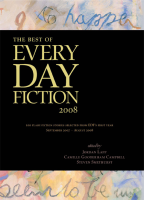
Best of Every Day Fiction NOW available for order

The Best of Every Day Fiction 2008 (Anthology)

From the press release:

Flash fiction is generally recognized as being fiction under a thousand words – the perfect length for a coffee break – but despite its appeal as a quick read, it is not simplistic. Quite the opposite; it can and should be one of the most demanding literary forms, with a need for perfectly crafted prose, a complete story arc in a tight space, and an immediately engaging hook.

The Best of Every Day Fiction 2008 brings together one hundred flash fiction pieces selected from Every Day Fiction’s first year of publication. These stories cross boundaries of genre and geography, with tastes of science fiction, humour, romance, fantasy, horror, and surrealism alongside the more traditional literary pieces, from authors writing in Argentina, Belgium, Brazil, Canada, Finland, India, Israel, Nigeria, the United Kingdom and the United States.

The anthology features all three of my stories published in EDF’s first year, One Question, The Breach, and Spring Melt as well as 97 other wonderful stories. For before-Christmans shopping, shop at EDF, hard-back or soft-back available. Hurry, the time frame is slim.

Mammoth in Late November

Want to share some pix from our holiday with Hillary. We cooked an 18 pound turkey for five, mashed potatoes, the works. It was fun and different. I wrote a lot too, working on my Rose Metal Chapbook entry (shout out to Sarah for sticking with me to make the deadline). Actually, writing on a vacation is usually so hard for me. I want to play cards, hike, help with the jigsaw, but this time, I could focus. I don’t know if it’s because I’d just spent to concentrated weeks on jewelry-making and was still in that “get it done” state of mind or if it was Sarah’s faith in me that I could do it, but it all balanced out nicely. We went out into a meadow near McGee’s Creek with the dogs, Hill helped me with a couple stories, we watched football, it was very cool.
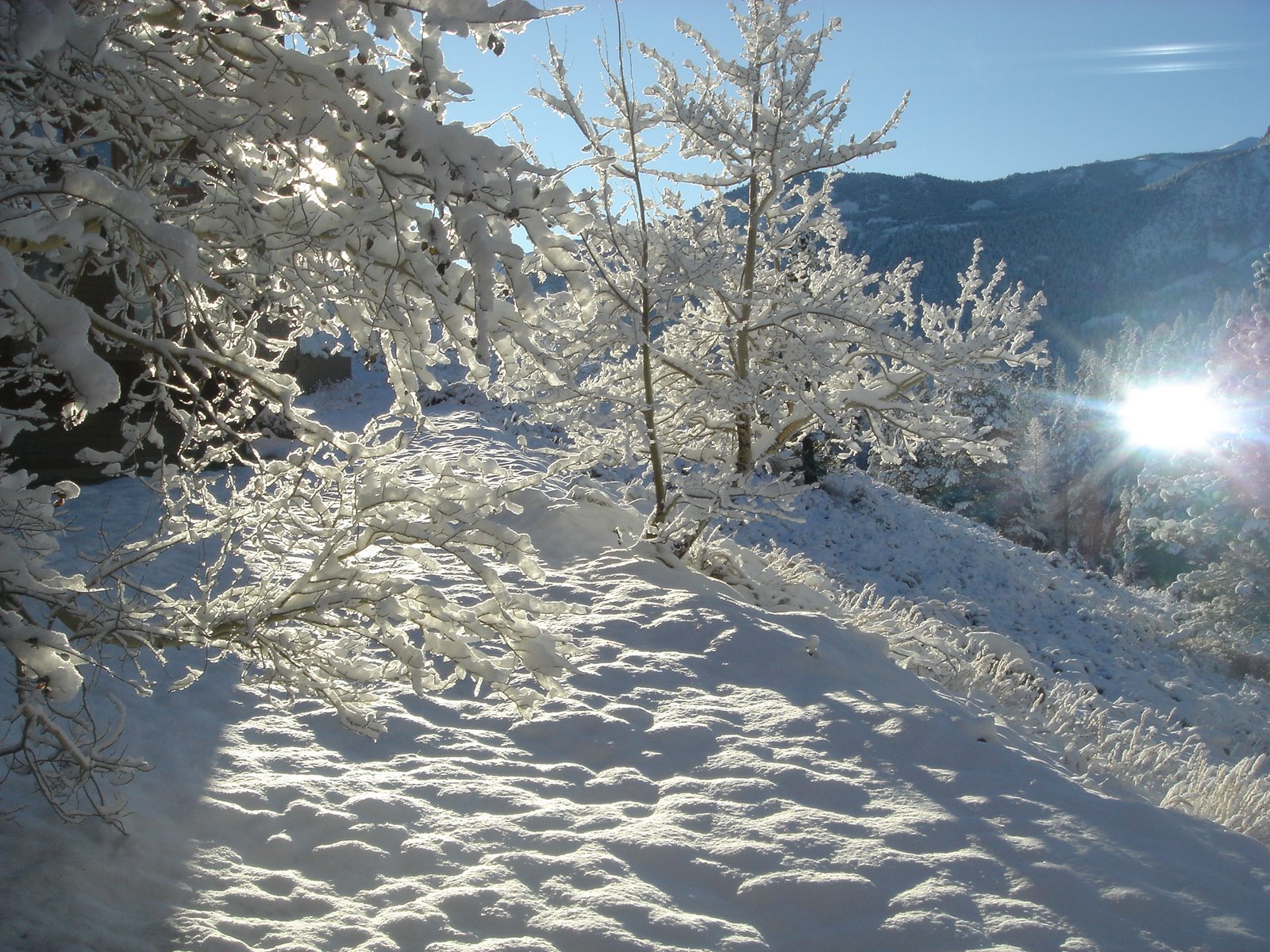
The weather too was balanced. Snow the day and night we arrived. Bright and sunny the rest of the time.
The morning after we arrived, I pulled the blinds and the sun, snow, and landscape sparkled right into the condo. Amazing.