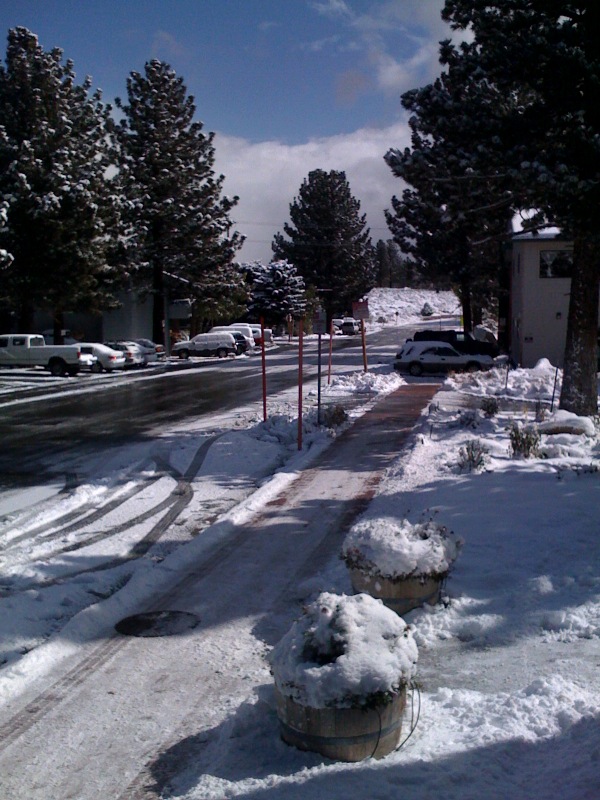
October 9
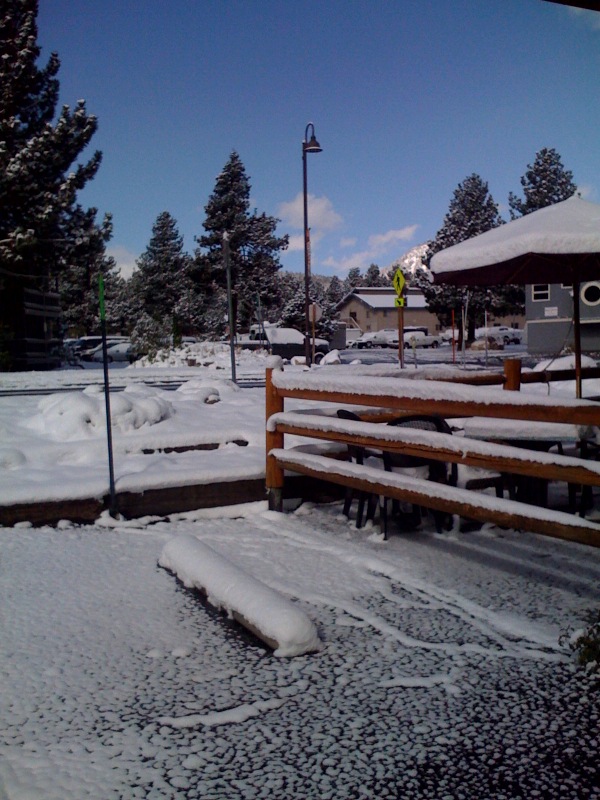
October 10
Spilled by The Beans!


October 9
October 10
Spilled by The Beans!
Robert, don’t quit the forums (fori? forae?) and certainly don’t let anything I’ve said, or Kevin for that matter, be a big deal to you. Our writerly egos and fears are involved, and therefore, we’ve got to say to ourselves “If it doesn’t speak to me, let it be.”
Writing about individual process always stirs people up. And makes for a lively discussion which is always to the good. The process is something we all want to understand. We strive to learn tricks, pray for shortcuts, hope and wish Jessica Lange or Andre Ethier will show up and be our muse. Anything that might our task easier. At least I do.
When something worksand someone else shares his secrets, we often want to put our hands over our ears and sing “la-la-la-la!” We don’t want to know that what’s working for us isn’t right.
The irony is that it’s all right. There is NO WRONG WAY, no wrong philosophy.
We choose our direction at each sign post and hope that it’s going to lead us where we want to go. Sometimes something learned works forever. Sometimes we hit a deep box canyon with no path to the top. Yet it’s hard to turn around and retrace our steps.
If one writer cares about other writers, and about the art and craft of writing, she sharea the reasons for her chosen path. Why?
If I’ve figured out something that works, just a tiny part of the process of writing (I don’t pretend to more because I don’t know a millionth of what there is to learn and know), I don’t want someone I know to struggle to find that same answer if I can give her some information, a hint, a trick, a 3 minute muse.
I’ve been writing a long time, and only now am able to write 1000 words that someone just might say they enjoyed. Maybe I should’ve given up. Maybe I wasn’t always listening. But I didn’t quit because whenever I got really stuck, the universe dropped a book in my lap (Jerry Cleaver, Natalie Goldberg, Stephen King), delivered a Writers Digest, alerted me to a workshop, or blessed me with an astute and honest reader.
So now I’m always listening, but I’m also filtering. Using what I tantalizes me and/or what I can believe in, and ignoring the rest.
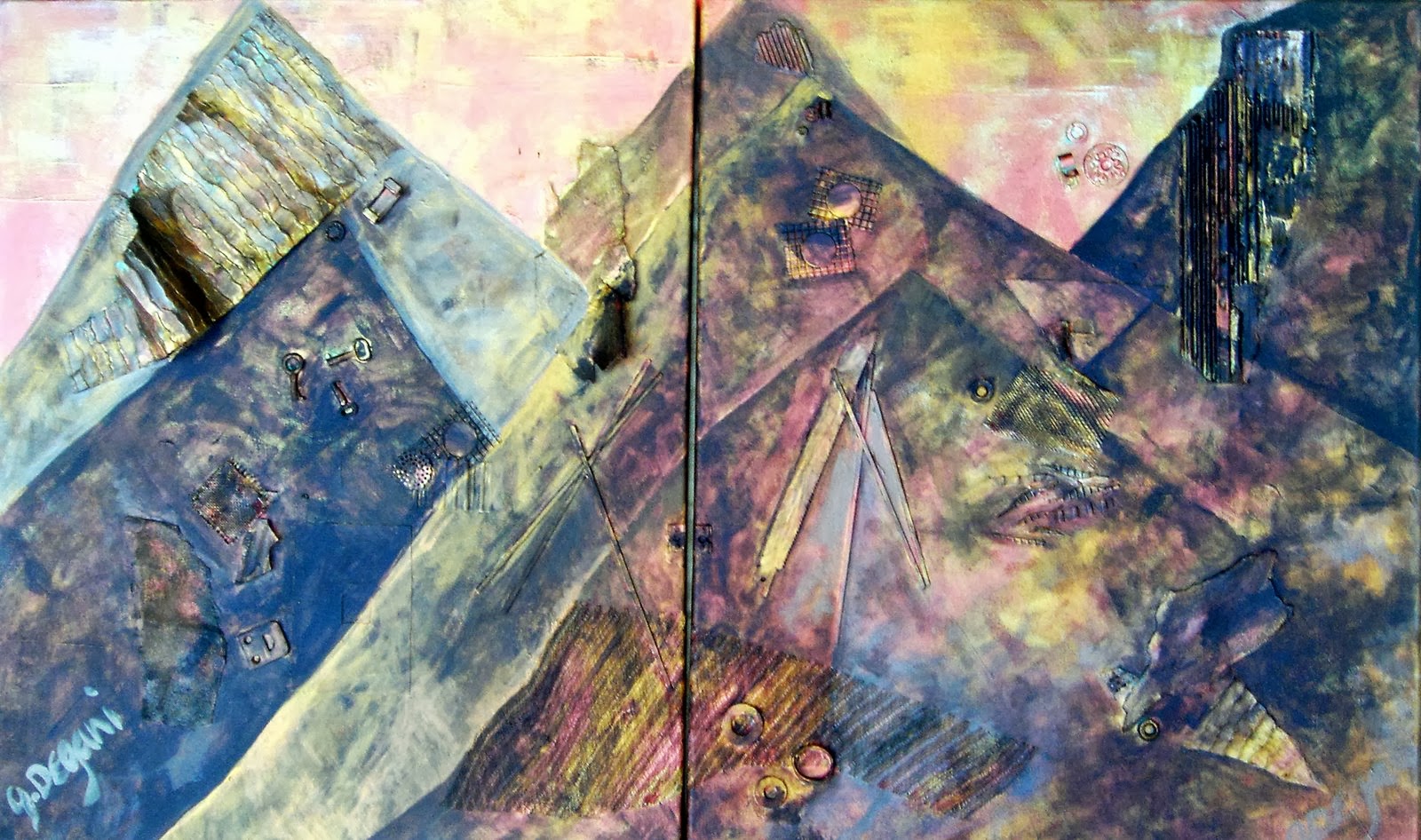
For you, Kevin, since you can’t come to the show.

To come and see my art? As unbelievable as it may seem, my art is hanging right at this very moment at The Masters Hair Studio and Gallery at 16 North Mentor in Pasadena. Email me for hours.
The show is called “Testing Mettle,” all puns intended. I use acrylic, wire, plastic, netting, fabric, and the metal street sweeping bristles I’ve gathered from the byways of South Pasadena. My commentary reads,
Gay Degani’s art focuses on alienation, discovery, reclamation, and growth from both personal and universal prospectives. Is there hope? Maybe.
Here’s a little sneak peak:

My friend Robert at Every Day Fiction brought up an interesting question today. Here’s what he asked me:
Gay mentioned that “there are no new stories in the world, just each person’s unique way to tell them.” I’m wondering, Gay – do you really believe this?
Personally, I think this is a pessimistic viewpoint. Because when I hear writers say that there is no such thing as originality anymore, that every story is influenced by another story which was influenced by another story, it makes me ask then what’s the point in even writing to begin with. I’ll agree, everything is influenced by everything else (both consciously and unconsciously) but I think it’s our job as writers to try to tell new stories, keep originality alive, etc.
Here’s my response:
Very good point for discussion, Robert. I probably should have used the word “plot” instead of story. Story combines all the compenents a tale weaves together to give the reader a unique experience. However plot is a single element or thread to the story’s “structure.” I should clarify here.
I consider that all stories have three overriding building blocks: content, structure, and language. Content is the actual meat of the story, the characters, the setting, and of course how the character react to specify events or plot of the story. Structure is the organization of the story, when the events happen, when the reader learns certain information, and the “plot.” Language is how this is all said and includes tone, attitude, and word choice.
It is helpful to me as a writer to understand that there ARE three building blocks to creating a story and that although there is much overlapping of these three key components, looking at them individually helps me to weave all of this together for the best effect. Theme emerges from, and is enhanced by, all three: content, structure, and language.
When I suggested there are no new stories, I was talking about plot in terms of its most primitive definition, in its most primitive form: What happens?
For example, in a love story:
Boy meets girl, boy loses girl, boy battles to get girl back, boy wins girl back(American movies) or loses girl(foreign movies).
That’s the plot. Three acts: Act 1, a longer Act 2 with two distinct halves, and Act 3. Personally when I’m working on structure I call these Act 1, Act 2A, Act 2B, and Act 3, each act roughlty equal in length. It’s helpful to me to break down my story whether 1000 words or 3000 words into these segments. It give me a handle on the action, the pacing, and the emotions.
Yes this sounds like formula, but plot is formula, and not to be confused with what a writer is going to do with the deeper structure, the theme, the characters, the language.
In the example above, where boy meets girl, the story question or plot question or premise is: Will the boy end up with the girl? That’s the plot of a love story. Period. What an individual writer chooses to weave in and out of her story to deepen it, depends on the writer’s point-of-view, her language, her understanding of structure, the choices she makes in setting, character, and tone. This plot is about man v. whatever for the love of girl.
The key to the most elemental plot is Aristotilian: What will the protagonist struggle against and will he win or lose?
The most basic plot setups are man against man, man against society, man against nature, man against himself, and of course in our new space age, man against machine which is really bastardized nature. All plots can be reduced to this question once you clear away all the other layers writers put into their work.
So will the protagonist struggle against an adversary for the one he/she loves and win or lose him/her in the end? Romeo and Juliet, Wuthering Heights, Die Hard.
Will the protagonist struggle against the forces of society and win or lose? One Flew over the Cuckoo’s Nest, Hedda Gabler, Erin Brockovich.
Will the protagonist struggle against the forces of nature and survive or die? Moby Dick, Old Man and the Sea, Ghostbusters.
Will the protagonist struggle against himself, his own wretched nature, his own weakness, and win or lose? Anna Karenina, Dorian Gray, Hamlet?
From these basic premises, stem all plots, but as you can see from my examples , none of those stories turned out formulaic or linear because it is the writer and the magic of the details and attitude of the writer that transforms plot. Classics usually manage to combine some or all of these basic premises.
The reason I’m going into this (I hope clearly but maybe not) is that unless we understand the basic elements of any skill, we can never truly master it. I fumbled around for years because I believed if I was to be a writer, some force outside myself (God, talent, DNA) would make it happen.
This is true of geniuses like the Brontes, maybe, Jane Austin, William Shakespeare, but most of us aren’t them. There is still the rest of us who have things to say in language that is valuable, touching, lyrical, magic, but most of us can’t turn our back on the continual lessons available to us about the craft.
Robert, I’m not directing this at you. You ask the question we all ask and most of us keep asking. But what I want to forestall is the doubt and fear in developing writers when they feel they cannot think of anything new. Too often a writer comes up with a twist only to read a book the next week and find the same idea illustrated. However, these gets washed away when the writer impresses his own thoughts and personality onto his own piece.
Newness is not in the plot. Newness–uniqueness– is in the writer himself. Everytime a writer sits down to write, if he worries about the story-as-in-plot being original, then that writer is going to eventually give up.
If, however, when he starts tapping the keyboard, he thinks about everything else, things he knows, things that interest him, people who live under his nose that bug him, if he considers the way his own street looks like on a Sunday morning at 5:30 with its overhanging camphor trees, the tiniest glitter of light behind the water tower, the small arch in the middle of the asphalt with its freshly painted yellow stripe–damn the city for that one–and oh, there’s a woodpeckerknocking his head against the lifeless electric pole….
And once that writer gets all his own uniqueness down, if he then goes back and thinks about what he has said, what is the truth that’s seeping out, and considers how to say it better and more beautifully, sharply, or angrily, then he’s on his way to a story people may want to read.
Phew Okay. Sorry about that. Hope my rambling convictions clarify that my view is anything but negative. My view is to say, you can do it, just be you, write what you want to write, then make it better.
Thanks Robert! I have my blog for today!!
I caught myself editing an LA Times headline this morning. Not the first time either. The only journalism classes I ever had were in high school. I was, of course, on the paper and thought that’s what I’d be, the next Nellie Bly. You know, the kind of woman played by Rosalind Russell. But alas I didn’t pick my college–I won’t go into that–and it turned out NOT to have a journalism department. Back in the day, it never occurred to me that there was such a thing as J-schools for college grads. Actually, was there? I wouldn’t have gone anyway. I wasn’t into clear thinking or assertive behavior in those days.
Anyway, I learned all the basics in Mr. Ritche’s class. (I can’t remember how to spell it, that’s how long ago it was). I understood how the inverted pyramid worked and why. I searched out words like “very,” “just,” “pretty,” and eradicated them. I tried to avoid the prepositional phrase in favor of strong adjectives and the occasional, even stronger verb. I probably forgot a lot, but when I see unnecessary words, it bugs the **** out of me.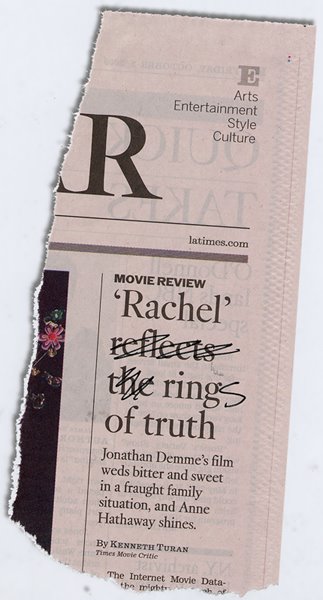
New story “Dani-Girl’s Guide to Getting Everything Right” is up at Flash Fiction Online TODAY.
Here’s a direct link to the story:
For individual links, go here.
Oct 1 Kevin Jewell Enter Not
Oct 2 Barry Davis Devil Do
Oct 3 Rumjhum Biswas My Daughter
Oct 4 Dave MacPherson Gallery Four
Oct 5 Jason Stout The Unstoppable Evelyn McHale, May 1, 1947
Oct 6 Oonah V Joslin You Must Remember This
Oct 7 Richard Lamb The Watch
Oct 8 Kevin Shamel Outlast the Stars
Oct 9 Amy Corbin The Adoption
Oct 10 Brian Dolton Weaving Fancies For The Children
Oct 11 Acquanetta M. Sproule Dern Spot
Oct 12 Sarah Black Pies of God
Oct 13 Milan Smith Sasha’s Knee
Oct 14 Douglas Campbell Forlorn Hope Fancy
Oct 15 Jonathan Pinnock Visiting Time
Oct 16 K.C. Ball In His Prime
Oct 17 Celeste Goschen Life Without Jerry
Oct 18 Stephanie Siebert Greedy
Oct 19 Robin Vandenberg Hernfield Sea Shell
Oct 20 Alexander Burns Apotheosis Cake
Oct 21 Joshua Reynolds Rush Hour
Oct 22 Nuala Ní Chonchúir Roy Lichtenstein’s Nude In A Mirror: We Are Not Fake!
Oct 23 Sarah Hilary Revenge of the River Gods
Oct 24 Ann M. Pino End Times
Oct 25 Erin M. Kinch A Million Faces
Oct 26 Iggy Smythe Any Rapport In A Storm
Oct 27 Jim Harrington The Kiss
Oct 28 Sylvia Spruck Wrigley Darren Is Updating His Facebook Status
Oct 29 Tels Merrick All of My Heart
Oct 30 niddy Monster in the Attic
Oct 31 Kyle White Sweet Bite
First, because it has import on a larger scale, I was pleased this morning to read an essay in the Wall Street Journal by Peggy Noonan called “A Hope for America” and no, it isn’t all-about-Obama. It focuses on the big picture, AMERICA as a concept as well as a country, and the state of things, the emotional well we seem to find ourselves in, and what our candidates should have their eyes on. I recommend the article if not the book (of course, there is a book which I haven’t read yet since I just heard about it). Here’s a quote that sums up the solution she advocates in her article.
“What we need most right now, at this moment, is a kind of patriotic grace–a grace that takes the long view, apprehends the moment we’re in and eschews the politically cheap and manipulative.”
Second, because she is a friend and an excellent writer, Anne-Marie Gomez makes her debut at Every Day Fiction today with her story “Lester’s Lucky Day.” It’s crackerjack. Go immediately to EDF, do not pass go, do not collect $200.
Yep, I’m excited! October 2 is the day Flash Fiction Online will publish “Dani-Girl’s Guide to Getting Everything Right.” This is the story I wrote in the summer after reading Ron Carlson’s “Ron Carlson Writes a Story.”
I did exactly what he said. It was a Tuesday, one of my two days a week I can count on not being bugged by the real world. I sat down in the morning with a title and a vague idea about what I wanted the story to be. Actually, it was a story I’d written years ago, but it had fallen flat and I filed it in some deep-six archive on my hard-drive. The original concept was still a good one, so I decided to tie the story to the new title that had popped into my head. The title supplied the framework or skeleton on which to hang the story. It gave it attitude.
Carlson says the trick is to stay in the chair. Haha! Easier said than done. BUT in his book, he coaches you. Here’s the first sentence. Don’t worry about it. What do you know about this first part that is important to tell the reader? See it. Write that down. Don’t worry. You can fix it later. What next? What else do you happen to know?
Well, you get the drift. And it was amazing. When I had the urge to leave the chair, my stomach growling, my body itchy, my mind wandering toward the television set, I told myself, wait, stay put, what else do you know. And I knew something else. “Dani-Girl,” “The Breach,” and “One Question” are the only three stories that flowed out. Boom. There they were with only a little revising, a little editing. And there’s always editing and revising. Don’t tell Ron, but I would have revised his first sentence in his example in the book had “The Governor’s Ball” been my story! Ah, but his whole story worked so another lesson. Things don’t always have to be perfect!
Getting a story from beginning to end doesn’t always work this way, but when it does, it’s a reward for all the times it doesn’t flow.
I hope you all read it and like it. Let me know what you think. October 2.
 Gay Degani